The Forts of Salvador from São Marcelo to the Barra lighthouse
The forts of Salvador in 2026: the Museu Náutico in the Barra lighthouse fort, the Verger and Carybé spaces at Porto da Barra, São Marcelo's reopening plan, hours, tickets and a sunset route.
The essentials in 30 seconds
The forts of Salvador went up between the 1580s and the 1740s to guard the capital of colonial Brazil and its bay. In 2026 three are easy to walk into: the Forte de Santo Antônio da Barra, which carries the lighthouse and the Museu Náutico da Bahia (R$ 20, about US$ 4), and the two small forts at either end of Porto da Barra beach, home to the Pierre Verger photography space and the Carybé art space (R$ 20 for both, free on Wednesdays). The round Forte de São Marcelo in the bay has been closed since 2011; the Bahia state government took it over in 2026 and has until about mid-2028 to reopen it. The rest you admire from outside, except the Forte da Capoeira in Santo Antônio Além do Carmo, which opens for capoeira.
Why Salvador needed so many forts
Salvador was founded on 29 March 1549 by Tomé de Sousa, the first governor-general, and stayed the capital of Portuguese Brazil until 1763, when the administration moved to Rio de Janeiro. The government and the colony's main port sat on this ridge, and all of it depended on the Bay of All Saints. The defence grew into a system you can still trace: guns on the Barra point covering the mouth of the bay, small forts at Porto da Barra covering the easiest landing beach, a fort in the water covering the harbour, and bastions on the high ground covering the roads in from north and south.
It failed once, badly. In May 1624 a Dutch West India Company fleet under Jacob Willekens and Piet Heyn landed troops at the Barra; the fort on the point was taken on 9 May without a fight, and the city fell within a day or two. A Spanish and Portuguese armada of 52 ships under Fadrique de Toledo, the expedition Brazilians call the Jornada dos Vassalos, besieged the Dutch from early April 1625, and they surrendered at the end of the month.
The lesson stuck. Most of the stone you see today was laid between the 1650s and the 1740s, and when Johan Maurits of Nassau-Siegen, the Dutch governor in Pernambuco, attacked in April and May 1638 with some 30 to 45 ships and around 4,600 men, the city held: the defenders under the Count of Bagnolo and Luís Barbalho kept the attackers outside the lines until they withdrew. In the 1800s several forts became prisons, which is why the Malê uprising of 1835 runs through their stories. In 2017 five of them were named among 19 Brazilian fortifications put forward together for World Heritage status. For the wider story, see our history and Afro-Brazilian heritage page.
The forts at a glance
| Fort | Present structure | Where | Open to visit in 2026? | What is inside now |
|---|---|---|---|---|
| Santo Antônio da Barra | 1696-1702 (first fort 1580s) | Farol da Barra | Yes, daily (works to 2027) | Museu Náutico da Bahia, lighthouse |
| Santa Maria | begun 1614, rebuilt 1690s | south end of Porto da Barra | Yes, Wednesday to Monday | Espaço Pierre Verger da Fotografia Baiana |
| São Diogo | early 1600s | north end of Porto da Barra | Yes, Wednesday to Monday | Espaço Carybé de Artes |
| São Marcelo | 1608-1623, rebuilt 1650-1728 | in the bay off the Comércio | No, closed since 2011 | Empty; restaurants and shows planned |
| São Pedro | begun 1627, inaugurated 1723 | Campo Grande | No | Army units |
| Santo Antônio Além do Carmo | 1695-1703 | Santo Antônio ridge | Yes, around capoeira activities | Capoeira academies |
| Barbalho | earthwork 1638, stone from 1667 | Barbalho | No | Military Police barracks |
| Monte Serrat | 1690s-1742 | Ponta de Humaitá | Outside always; inside some days | Museu da Armaria (arms) |
| São Paulo da Gamboa | 1714-1720 | Gamboa de Baixo | No | Homes of local families |
Forte de Santo Antônio da Barra and the Museu Náutico
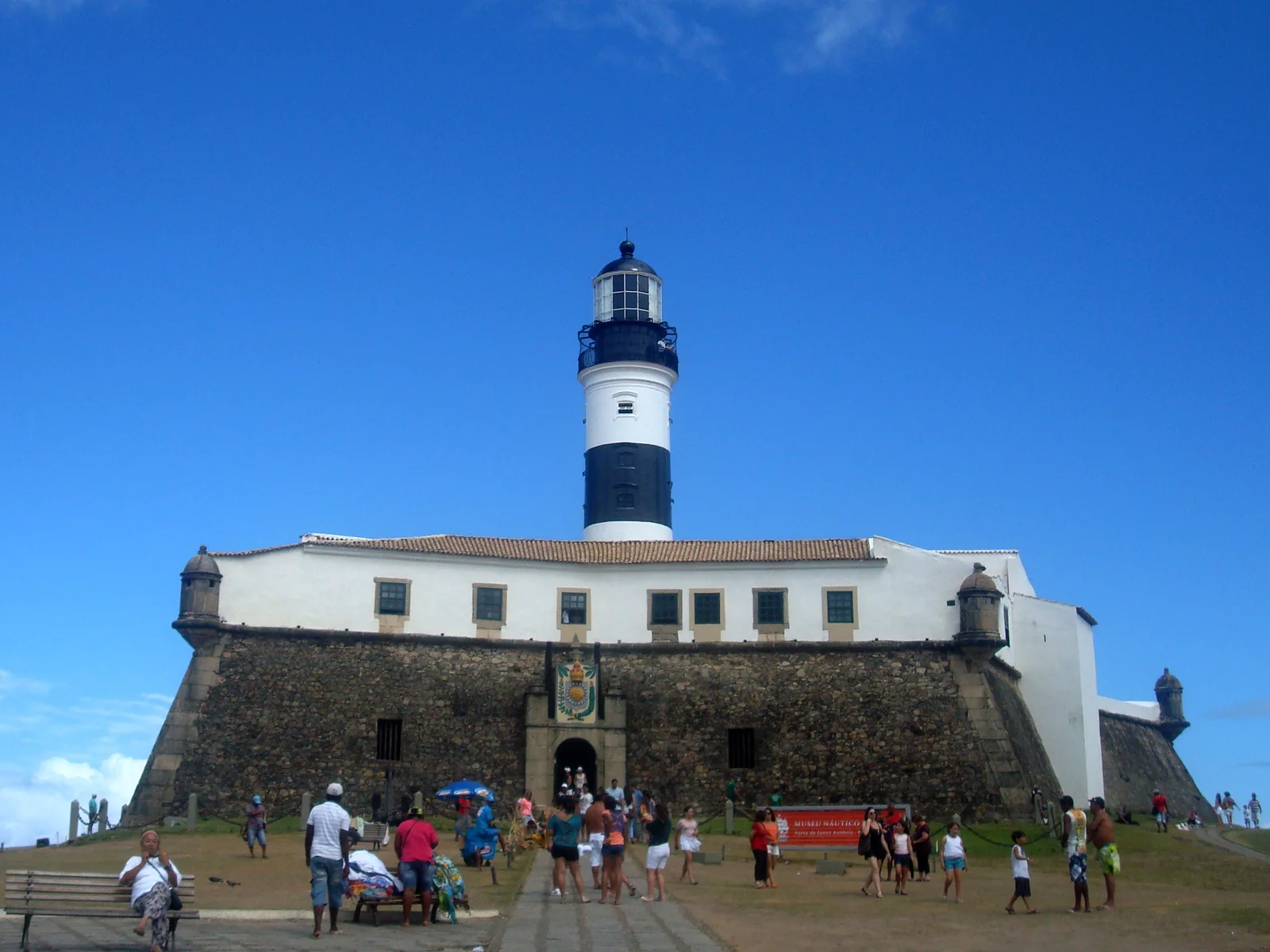
The fort on the Barra point is the oldest position in the system: a first fort stood here by the 1580s, it was rebuilt in stone from 1596, and the many-sided outline you walk around today dates from 1696 to 1702. The lighthouse came out of a disaster. On 5 May 1668 the Santíssimo Sacramento, flagship of the Companhia Geral do Comércio do Brasil, was wrecked off this coast, and when the fort was rebuilt a whale-oil light was added, first recorded in 1698: the first lighthouse in Brazil and, by most accounts, in the Americas. The present tower was inaugurated on 2 December 1839, the light apparatus followed in 1890, and it was electrified in 1937. The Brazilian Navy still runs the fort and the light.
The museum opened on 10 December 1998. Our Barra guide and museums guide give it a paragraph each; inside, the heart of the collection is what divers raised from the Sacramento after about 300 years under water: coins, seals, jars, tableware and military gear. Around it are navigation and signalling instruments, ship models and a permanent exhibition on the Bay of All Saints and the city's maritime and military life, plus a rotating temporary show. Finish on the upper terrace.
Two things most visitors miss. From mid-July into October the fort is a whale-watching post: researchers from the Projeto Baleia Jubarte watch from the top of the lighthouse tower daily and share binoculars with visitors, and they logged about 1,400 humpback sightings here in 2025. And on the second-to-last Saturday of each month, from 17:00, the Astrônomos Amadores da Bahia set up telescopes on the terrace for "Astronomia no Farol", at the normal ticket price.
The works are aimed at visitors: in December 2025 the Ministry of Culture approved raising about R$ 551,000 (roughly US$ 106,000) for better access for people with physical disabilities, adapted toilets, lightning protection and new exhibit lighting.
Forte de Santa Maria and the Pierre Verger photography space
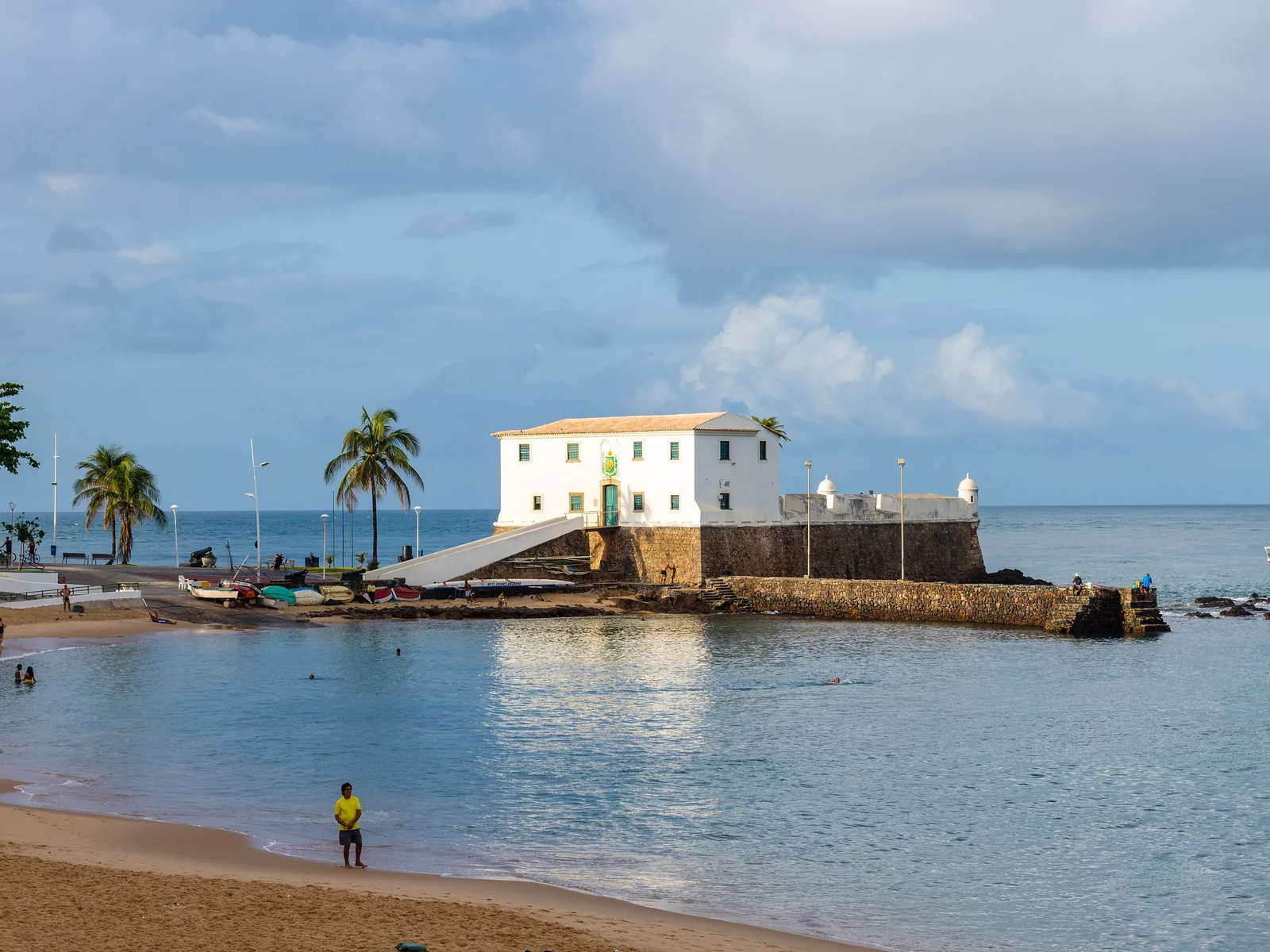
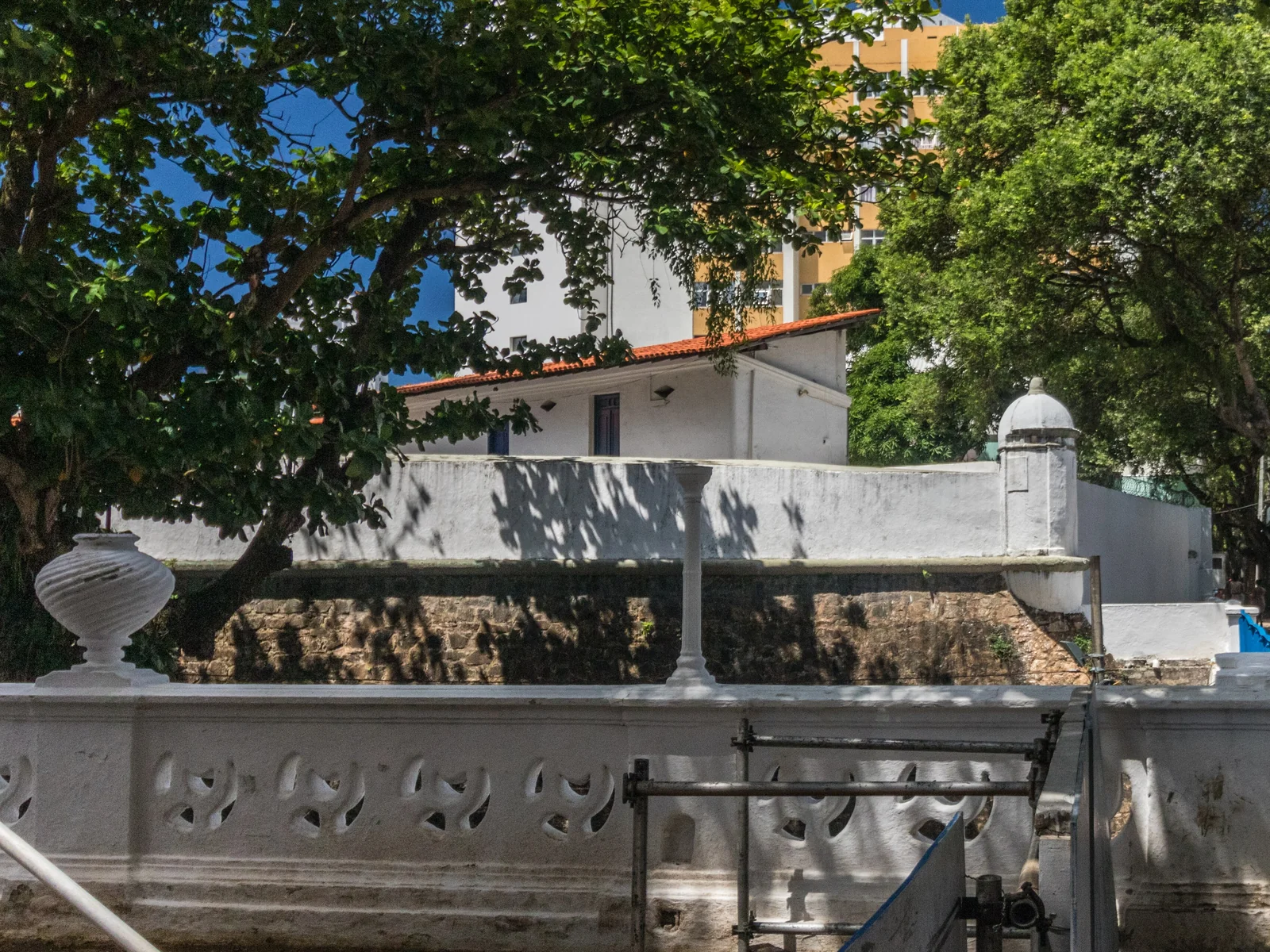
Porto da Barra was the site of Vila Velha, the first Portuguese settlement in Bahia, and the obvious landing beach, so two small forts at its ends caught boats in a crossfire with the big fort on the point. The Forte de Santa Maria, on the rocks at the south end, was begun in 1614 to a design by the chief engineer Francisco de Frias da Mesquita. It did not stop the Dutch: a plaque on the fort says their troops came ashore here on 9 May 1624. It held its corner in 1638 and took its present seven-sided shape in the 1690s under governor João de Lencastre.
Since 2016 it has housed the city-run Espaço Pierre Verger da Fotografia Baiana. Verger was the French photographer who recorded Afro-Bahian life, the candomblé terreiros and daily routines, above all in the 1940s to 1960s. The space is small (about 94 square metres at the opening) and uses projections and digital screens: his pictures sit beside work by Bahian photographers, more than 100 of them in the collection by 2023. Allow 30 to 45 minutes.
Forte de São Diogo and the Carybé art space
At the north end of the beach, the Forte de São Diogo dates from the early 1600s, though historians disagree on the exact years. Nearby stands the Marco da Fundação, a marble column with a tiled panel marking the 400th anniversary of the Portuguese arrival in Bahia. Inside the fort is the Espaço Carybé de Artes, opened in 2016. Carybé was the Argentine-born artist Hector Julio Páride Bernabó, who settled in Salvador and whose work portrays its street festivals, terreiros and working life. By 2023 more than 500 of his works had been digitised for interactive screens, and the space opened with virtual reality headsets that walk you through his studio in Brotas. One ticket covers both forts, about 400 metres of promenade apart.
Forte de São Marcelo, the round fort in the bay
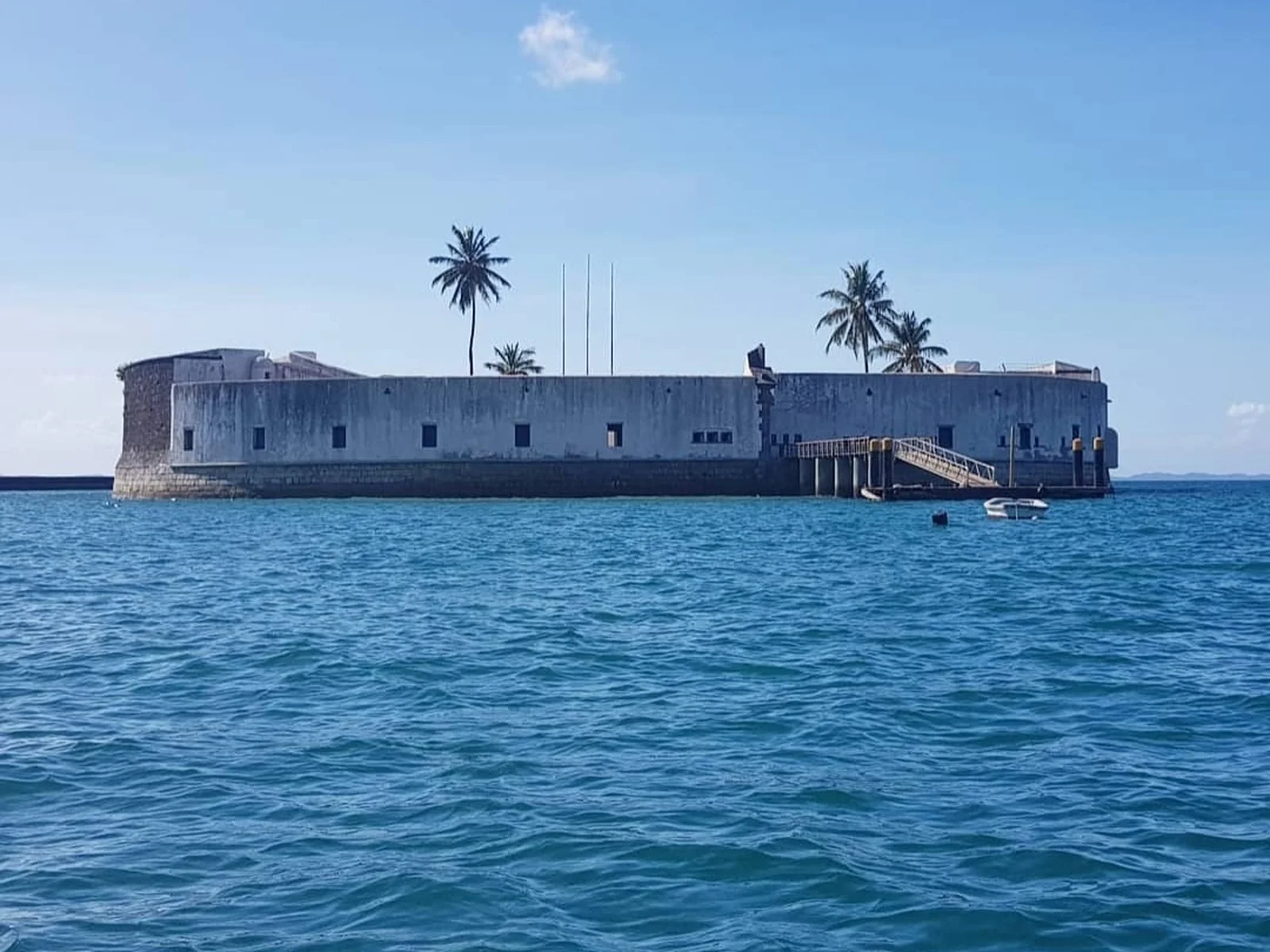
The stone drum on a reef about 300 metres off the Comércio is the only circular fort in Brazil: a central tower about 15 metres high and 36 metres across inside a lower ring wall. Designed in 1608 by Frias da Mesquita and finished in 1623, it was the first position the Dutch occupied in 1624, when its guns were turned on the town. A rebuild began after a royal order of 1650; it took the name São Marcelo in 1661 and was expanded from 1717 to 1728. In 1638 it helped keep the Dutch fleet at a distance.
From the 1820s until 1900 it was a prison. Its cells held men accused in the Malê uprising of 1835 and the leaders of the Sabinada revolt in 1838, and Bento Gonçalves, leader of the Farroupilha war in the far south, escaped from here on 10 September 1837.
Can you visit in 2026? No. It reopened to visitors in November 2004 under a partnership with a heritage NGO and closed again in 2011 as the structure deteriorated. IPHAN, the national heritage agency, spent about R$ 7.5 million (roughly US$ 1.4 million) rebuilding the tide-eaten walls, a job due for handover in November 2016, but no agreed use followed. On 4 May 2026 the federal government signed the fort over to the Bahia state tourism department (Setur-BA) for 20 years, with the fortress at Morro de São Paulo, and the order was published on 22 June 2026. The state has 24 months to reopen it, so around mid-2028. The plan described in July 2026 includes restaurants, a show space, a rebuilt landing pier and new services, with a private operator chosen by tender afterwards.
It is still one of the most-seen buildings in the city. The Praça Tomé de Sousa parapet and the top of the Elevador Lacerda look straight down on it, the waterfront behind the Mercado Modelo puts you level with it, and the lanchas to Itaparica and the cruises in our boat trips guide pass close by.
Forte de São Pedro on the Campo Grande
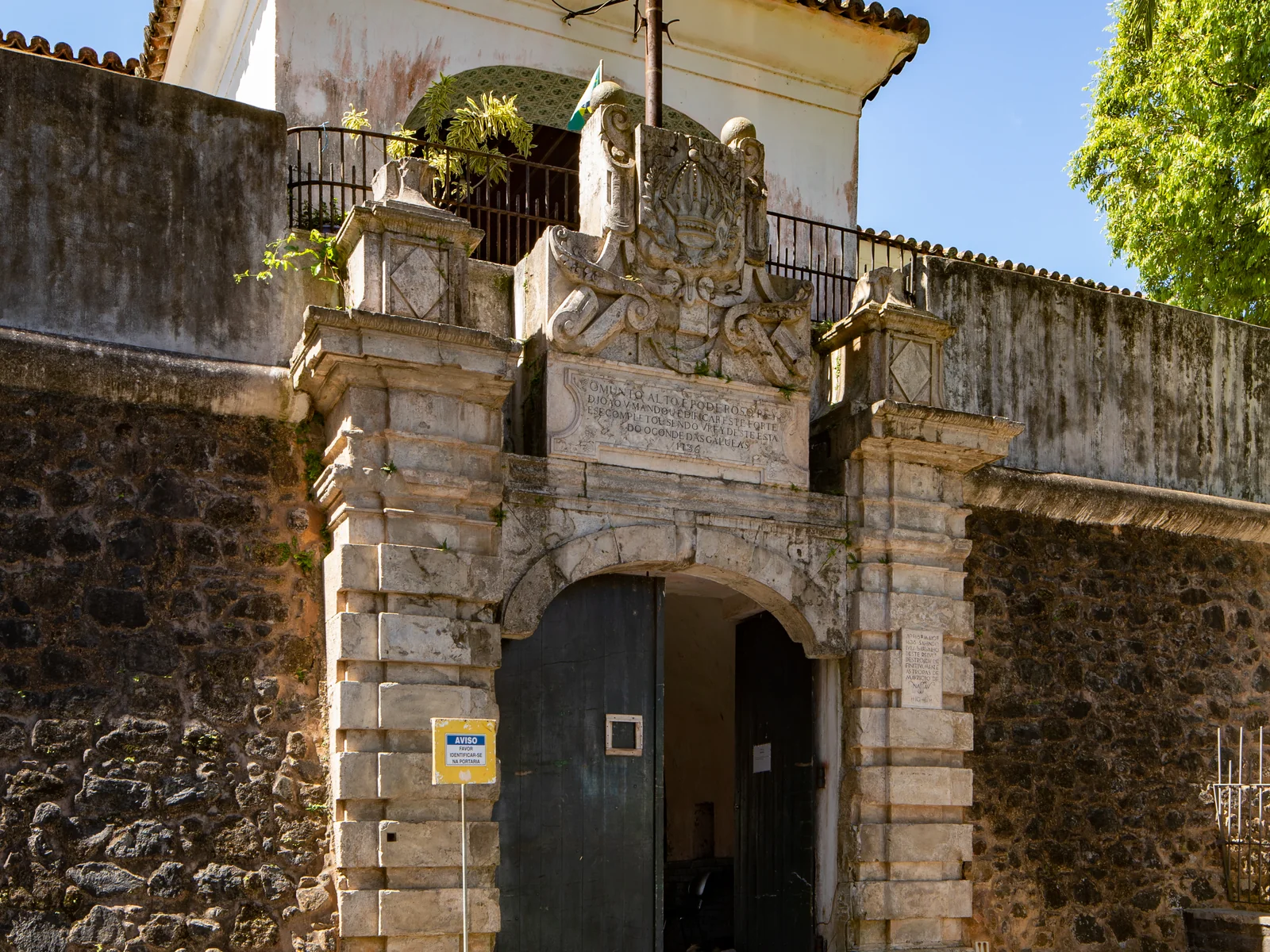
The bastioned fort beside the Campo Grande square was begun in 1627, rebuilt in stone from 1646 and inaugurated in 1723. In February 1822 it was the last position held by officers loyal to the Brazilian-born brigadier Manoel Pedro de Freitas Guimarães when the Portuguese commander Madeira de Melo seized the city, one of the clashes behind the war in our Dois de Julho guide. It is an active Army base; on 30 June 2025 its courtyard was renamed Pátio 2 de Julho in honour of the independence fighters. There is no casual visiting, but its long walls are easy to see on the way to Barra.
Forte de Santo Antônio Além do Carmo, the Forte da Capoeira
The fort at the end of the Santo Antônio ridge guarded the northern way into the city; the present building dates from 1695 to 1703. From 1830 it was a jail, holding men captured after the Malê uprising, and it held political prisoners under the military regime before closing as a prison in 1976. Mestre João Pequeno, a pupil of Mestre Pastinha, opened his capoeira Angola academy here in 1981; after a restoration finished in 2006 it reopened as the Forte da Capoeira, run by the state heritage institute IPAC since 2007. Go in the late afternoon or evening, when the academies train. Our capoeira guide and the Santo Antônio Além do Carmo guide cover the classes and the neighbourhood.
Forte do Barbalho
In the Barbalho neighbourhood, a short way inland from the Santo Antônio ridge, the Forte de Nossa Senhora do Monte do Carmo began as an earthwork thrown up in 1638 by Captain Luís Barbalho Bezerra, who expected the Dutch to return. It was rebuilt in stone from 1667, served as a public prison from 1828, and now houses a Military Police barracks, so you see it from the street.
Forte de Monte Serrat on the Itapagipe peninsula
Out at Ponta de Humaitá, beside the little church of Monte Serrat and the lighthouse standing in the sea, this irregular hexagon with domed sentry posts at the corners guarded the city's northern limit on the bay. The stone fort was begun in the 1690s to a plan by the Florentine engineer Baccio da Filicaia and finished in 1742. A plaque records that the Dutch commander Johan van Dorth was killed on this spot on 17 July 1624. The Army looks after it, and since a 1993 restoration it has held the Museu da Armaria, a small collection of cannon and firearms. Opening inside is irregular (one city tourism listing gives Monday, Wednesday, Thursday and Friday), but the lawn and walls are always there, with the skyline across the water. It is about a kilometre past the Bonfim church; our Ribeira and Itapagipe guide covers the peninsula.
Forts you see only from outside
Forte de São Paulo da Gamboa. Below the Campo Grande at sea level, this battery was built between 1714 and 1720 to a plan by the French engineer Jean Massé, linked by a wall to São Pedro. Families of the Gamboa de Baixo fishing community have lived there since 1987, and in October 2024 a federal court approved an agreement for a restoration that keeps community use and housing for some families. It is a neighbourhood, not an attraction: see it from the water. Forte de São Lourenço, across the bay at Itaparica town, is covered in our Itaparica guide.
The Bahia de Todos os Fortes guided route
On 29 September 2025 the state tourism department and the Army's 6th Military Region launched a heritage route, "Bahia de Todos os Fortes", covering Monte Serrat, São Diogo, Santa Maria and São Pedro, with guides certified after a course on the city's fortifications. We found no public booking system in October 2026, so ask a guide registered with Cadastur, the national tourism register, whether they can include São Pedro and Monte Serrat, the two you cannot easily enter alone.
A fort afternoon in Barra, ending at sunset
Barra is about 5 km from the Pelourinho, 15 to 20 minutes by car outside rush hour; a ride-hail car costs roughly R$ 10 to 20 at normal hours (see what Salvador costs). Avoid Tuesday, when the Verger and Carybé spaces close; Wednesday makes them free.
- About 14:00: leave the Cidade Alta; via the Campo Grande you pass the walls of the Forte de São Pedro.
- 14:30: the Carybé space in the Forte de São Diogo, then the Marco da Fundação column.
- 15:15: walk the promenade to the Verger space in the Forte de Santa Maria; swim at Porto da Barra if the tide suits.
- 16:15: walk 10 to 15 minutes around the point to the Museu Náutico, inside before the 17:30 last entry, and end on its terrace.
- Sunset: the free lawn around the fort walls, or back to Porto da Barra; our sunset spots guide weighs the two.
For a second outing, take the Forte da Capoeira in the evening, or pair Monte Serrat with the Bonfim church on a morning. Ramparts mean steps, uneven stone and little shade, so carry water; our safety guide has the tips for evenings.
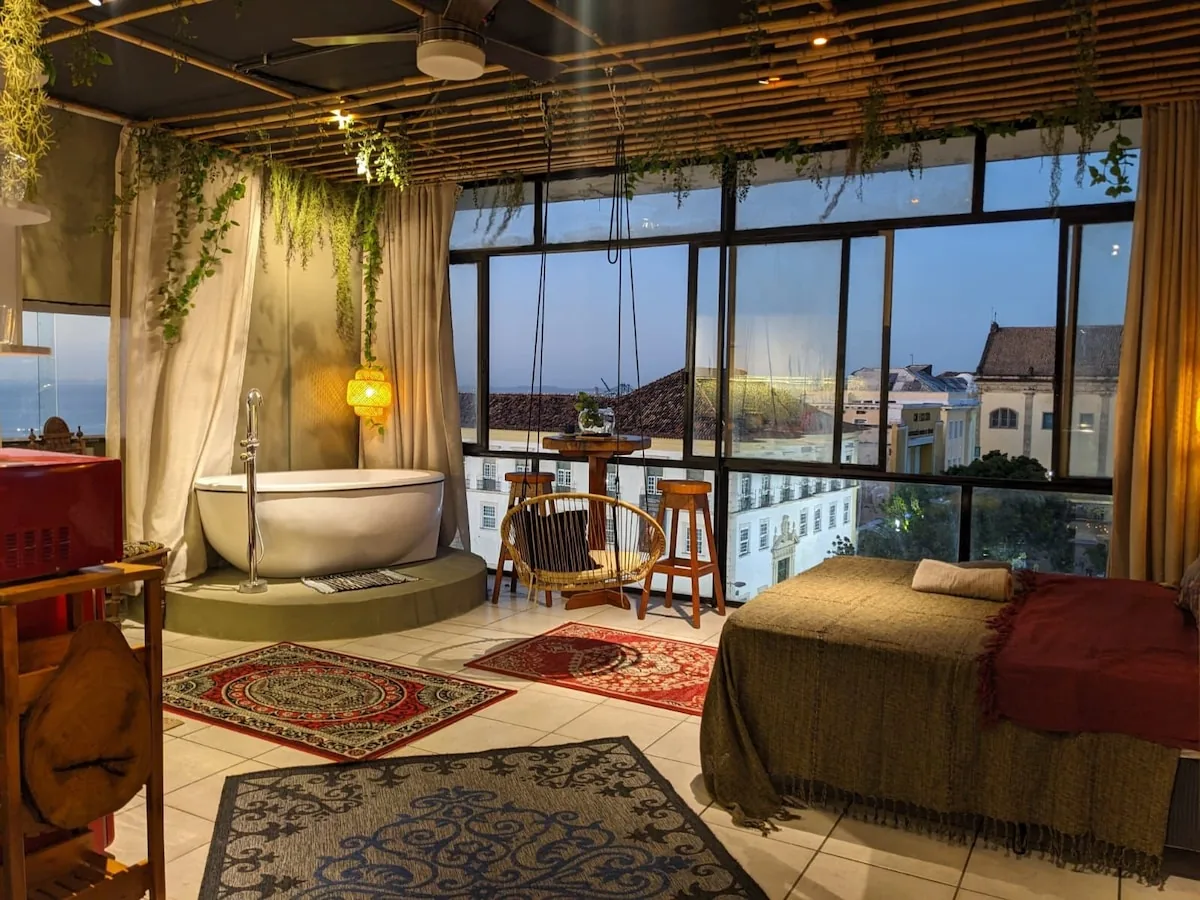
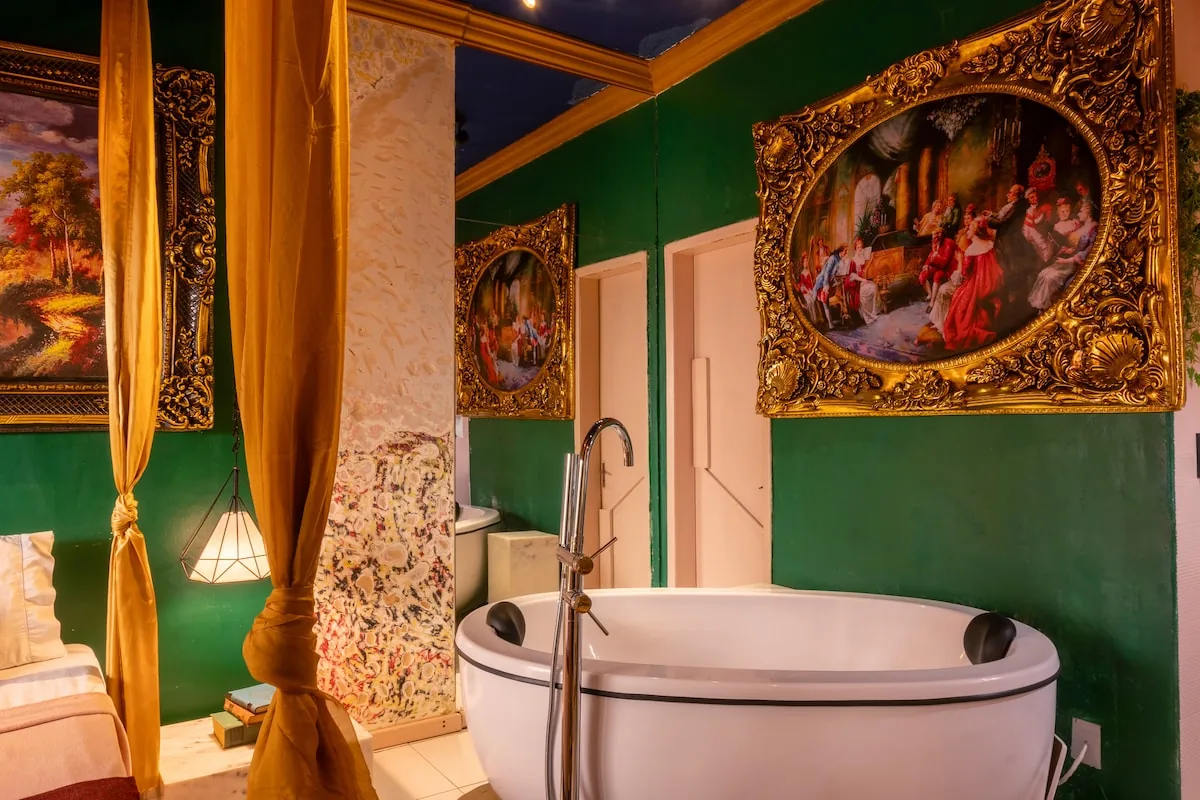
Our four suites sit in the Cidade Alta, a few minutes on foot from the Elevador Lacerda and the Pelourinho, so the São Marcelo view is at the end of the street and the Barra forts a short ride away. They are booked on Airbnb, where you message the host; see our four suites, and plot the forts on our map of Salvador.
Frequently asked questions
Can you go inside the Forte de São Marcelo in 2026?
No. It has been closed to visitors since 2011. The Bahia state tourism department took over its management for 20 years in 2026 and has until about mid-2028 to reopen it. For now, see it from the Praça Tomé de Sousa, the Elevador Lacerda or the boats to Itaparica.
How much does it cost to visit the Farol da Barra fort?
The Museu Náutico charges R$ 20 (about US$ 4), or R$ 10 for students, teachers, over-60s and Salvador residents; under-7s are free (October 2026). The lawn around the fort is free. Works run into the first half of 2027, so check the museum's site before going.
What is inside the forts at Porto da Barra?
Santa Maria, at the south end, holds the Espaço Pierre Verger da Fotografia Baiana; São Diogo, at the north end, holds the Espaço Carybé de Artes. One R$ 20 ticket covers both, entry is free on Wednesdays, and they close on Tuesdays.
Is the Farol da Barra the oldest lighthouse in the Americas?
It is generally described as the first in Brazil and on the continent: a light was first recorded on the fort in 1698, after the wreck of the Santíssimo Sacramento in 1668. The present tower dates from 1839.
Can I see whales from the Farol da Barra?
Yes, from mid-July into October, when Projeto Baleia Jubarte researchers watch from the top of the lighthouse and share binoculars with museum visitors.
Which Salvador forts can I visit without a tour?
Santo Antônio da Barra, Santa Maria and São Diogo, the Forte da Capoeira when the academies are active, and the outside of Monte Serrat. São Pedro and Barbalho are Army and police buildings, and São Paulo da Gamboa is home to local families.
Sources
- Museu Náutico da Bahia: Acesso (hours, prices; in Portuguese; checked Oct 2026), with its collection page and Astronomia no Farol.
- Wikipedia: Forte de Santo Antônio da Barra (dates, 1668 wreck, 1998 museum; in Portuguese).
- Travel.com.br: Farol da Barra será restaurado (works to 2027; July 2026; in Portuguese) and Bahia Notícias (Dec 2025 funding).
- Bahia Notícias: whale season at the Farol da Barra (July 2026; in Portuguese).
- Salvador da Bahia (city portal): Espaço Pierre Verger, June 2025 (hours, prices; in Portuguese).
- Bahia Notícias: Carybé and Verger in the Porto da Barra forts (July 2023) and its 2016 opening report (in Portuguese).
- Wikipedia: Forte de Santa Maria (in Portuguese) and Porto da Barra Beach.
- A Tarde: Forte São Marcelo cedido à Bahia (June 2026) and the July 2026 plan (in Portuguese).
- Jornal Grande Bahia: state takes over São Marcelo (May 2026) and Bahia Notícias on the 2016 works (in Portuguese).
- Wikipedia (in Portuguese): São Marcelo, São Pedro, Santo Antônio Além do Carmo, Barbalho, Monte Serrat and São Paulo da Gamboa (dates and uses; checked Oct 2026).
- A Tarde: Pátio 2 de Julho at the Forte de São Pedro (July 2025; in Portuguese).
- Bahia Notícias: Forte da Gamboa agreement (Oct 2024; in Portuguese).
- Portal IN: the Bahia de Todos os Fortes route (Sep 2025; in Portuguese).
- Wikipedia: History of Salvador, Capture of Bahia and Siege of Salvador (1638); Catraca Livre on the 2017 World Heritage bid.
Stay in the historic centre
Our four suites are in the Cidade Alta, a few minutes on foot from the Elevador Lacerda and the Pelourinho. They are booked on Airbnb.


Salvador, in images
Photographs of the neighborhood, restaurant, and beach featured in this guide, with credit to each photographer.
Ready to discover Salvador?
Book one of the four Via Avantgarde suites in the Pelourinho — and receive the complete guides with recommendations for your stay.