Hotels Near the Elevador Lacerda and the walk to each one
Hotels near the Elevador Lacerda in Salvador compared: the Fera Palace, Fasano Salvador, Villa Bahia and the Via Avantgarde suites, with walking times, rooms, pools and November 2026 rates.
The essentials in 30 seconds
Four places to sleep within a ten-minute walk of the upper door of the Elevador Lacerda, on the Praça Tomé de Sousa. The four Via Avantgarde suites are 2 to 6 minutes from the lift. The Fera Palace Hotel, on Rua Chile, is about 300 metres away (4 to 5 minutes); the Fasano Salvador, on the Praça Castro Alves, about 500 metres (6 to 7 minutes); and Villa Bahia, on the Largo do Cruzeiro de São Francisco, about 700 metres (9 minutes). Fera and Fasano are five-star hotels with rooftop pools and one MICHELIN Key each. Villa Bahia is a 17-room pousada in two 17th- and 18th-century mansions. Via Avantgarde is ours: private suites with kitchens, booked on Airbnb, with no front desk. For the night of 10 November 2026, the three hotels were asking R$ 1,331 to R$ 1,920 (about US$ 257 to 371); the suites ran R$ 345 to R$ 435 a night (about US$ 67 to 84) on two-night stays that month. The lift is free for now and runs 6.30 am to 9.30 pm on weekdays.
Why stay near the Elevador Lacerda
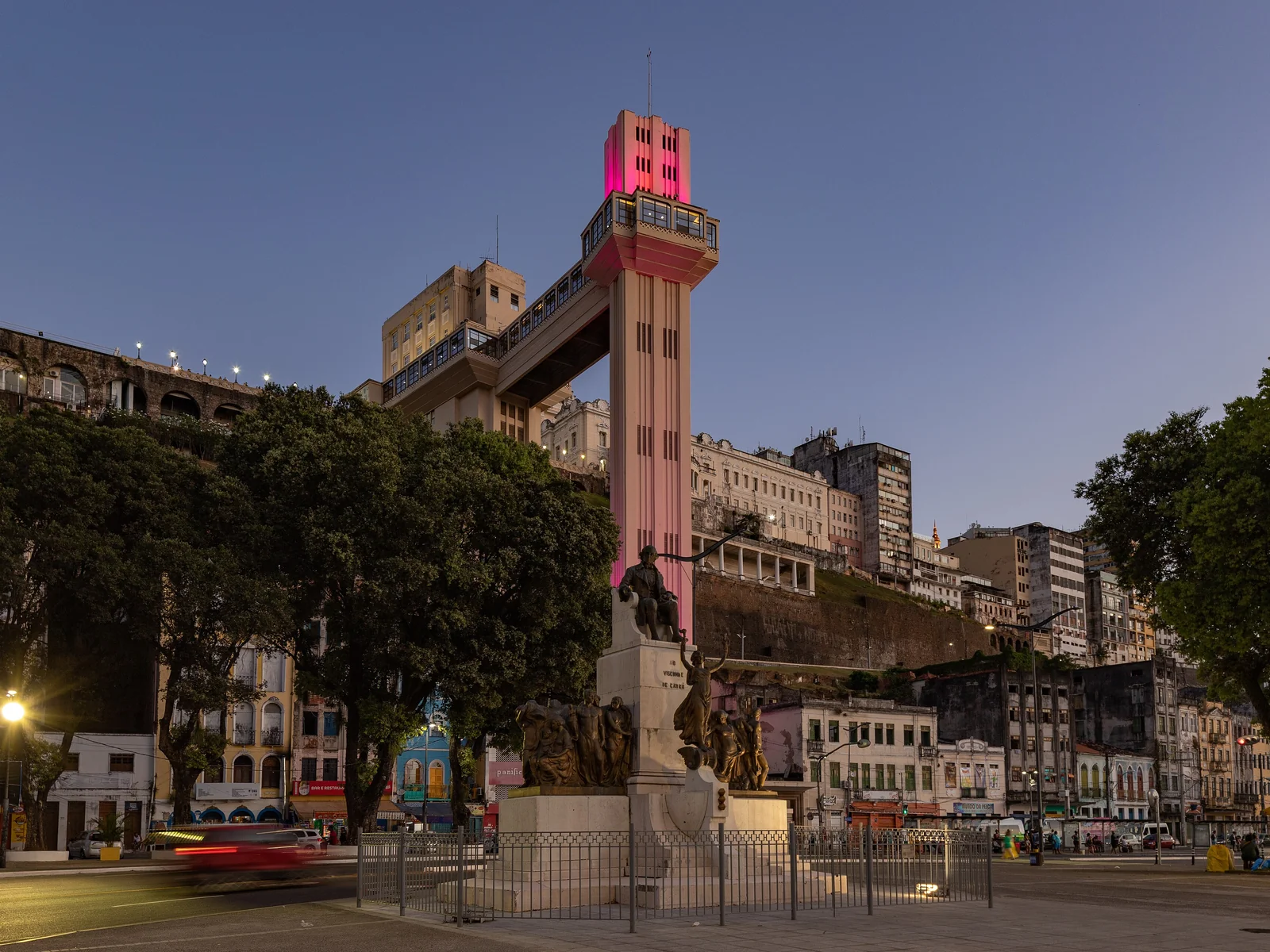
Salvador was built on two levels. Up top, in the Cidade Alta, are the Praça Tomé de Sousa, the Praça da Sé, the Terreiro de Jesus and the Pelourinho. Some 70 metres below lie the Comércio, the Mercado Modelo and the Terminal Náutico, where the boats leave for Morro de São Paulo and the island of Itaparica. The Elevador Lacerda is the hinge between the two: four cars drop 72 metres in about 30 seconds, as the city has done since 1873. The Art Deco tower on the postcards dates from the 1930 rebuild, and the whole structure has been a listed national monument since 2006.
Sleeping near the upper door buys you three things that never show up in a room photo. The first is time: the Pelourinho is about ten minutes on foot, and the market and the boats are one lift ride away, while guests out in Barra or Rio Vermelho pay a taxi and the traffic every time they want the old town. The second is light: the lookout on the Praça Tomé de Sousa faces west over the Bay of All Saints, so the sunset happens a few steps from your bed. The third is rhythm: an early coffee before the tour groups arrive, a break in your room in the midday heat, and dinner on foot.
The lift was closed for a full refurbishment from April 2024 until 26 February 2025, when it reopened with new cars. The city announced a R$ 1 fare for after the works, but in May 2026 it was still free for residents and visitors alike. It runs 6.30 am to 9.30 pm Monday to Friday and from 7 am on Saturdays, Sundays and holidays; the city's own historic-centre portal lists closing at 9.30 pm on Saturdays and 9 pm on Sundays and holidays. After that, the only link between the upper and lower city is a ride-hailing car.
How we measured the distances
Every distance in this guide starts at the upper door of the lift on the Praça Tomé de Sousa and follows pedestrian routes calculated on OpenStreetMap's open map data. We rounded to the nearest 50 metres and converted to minutes at an easy pace, the pace of someone carrying a bag and stopping to look at a church. The ridge of the Cidade Alta is nearly level between the Praça Tomé de Sousa, the Praça da Sé and the Terreiro de Jesus, but the ground is stone and some stretches slope, so thin sandals tire you faster than the distance suggests.
For the three hotels we measured to the official address: Rua Chile 20 (Fera Palace), Praça Castro Alves 5 (Fasano) and Largo do Cruzeiro de São Francisco 16/18 (Villa Bahia). For the Via Avantgarde suites, Airbnb only reveals the exact address after booking, so we give a range: two suites are on the square beside the lift, the Historic Loft is right next to it, and the Colonial Suite is on the way from the lift to the Fasano. Hence 2 to 6 minutes rather than a single figure.
A note about the other direction: you can walk down to the Comércio on the old ladeiras, such as the Ladeira da Misericórdia and the Ladeira da Montanha, but they are steep, empty outside office hours and pointless with luggage. The lift does the descent in half a minute, and that is the measure that matters when you sleep up top.
Side by side: distance, size, pool and price
| Where | Walk from the lift | Units | Pool | Sample nightly rate |
|---|---|---|---|---|
| Via Avantgarde | 2 to 6 min | 4 suites for 2 people | No; a tub in 3 of the 4 suites | R$ 345 to 435 (US$ 67 to 84) |
| Fera Palace Hotel | ~300 m · 4 to 5 min | 81 rooms and suites | Rooftop infinity pool, guests only | R$ 1,349 (US$ 260), official site |
| Fasano Salvador | ~500 m · 6 to 7 min | 70 rooms | Rooftop, lined in blue Bahia granite | from R$ 1,920 (US$ 371) |
| Villa Bahia | ~700 m · 9 min | 17 rooms | In an inner garden courtyard | R$ 1,331 (US$ 257) |
How to read the last column: for the hotels, it is the lowest price a hotel search engine showed on 27 September 2026 for one Tuesday night, 10 to 11 November 2026, for two adults; for the Fera, it is the official-site price. For Via Avantgarde, it is Airbnb's total per night, fees included, on two-night stays in November 2026 at the non-refundable rate; the refundable option cost R$ 30 to 40 more per night. The numbers do not buy the same thing: a hotel rate may or may not include breakfast, and a suite has no breakfast but does have a kitchen.
What the table cannot show is the kind of stay. The two five-stars sell service: a 24-hour front desk, a restaurant, a rooftop bar, daily housekeeping, someone to call your car. Villa Bahia sells the feel of a pousada, with few rooms, courtyards and breakfast served at your table. Via Avantgarde sells space and privacy: a small home of your own with code or smart-lock entry, a kitchen and, in three of the four suites, a soaking tub. Choosing between them means choosing what you want to happen once you close the door.
Fera Palace Hotel, on Rua Chile
The eight-storey corner building on Rua Chile opened in 1934 as the Palace Hotel, the first luxury hotel in Brazil's Northeast, in an Art Deco style the hotel says was inspired by New York's Flatiron Building. For decades it was the address for anyone passing through Salvador with money or fame, and the hotel likes to recall names that walked its corridors, among them Orson Welles, Pablo Neruda, Carmen Miranda and Jorge Amado. Decline set in by the late 1980s, the doors closed, and the building stood empty until 2012, when Fera Investimentos bought it. It reopened as the Fera Palace Hotel in 2017, in a project by the Danish architect Adam Kurdahl, and helped pull the rest of Rua Chile back to life.
There are 81 rooms and suites, from 18 square metres in the smallest up to the tower suite under the dome, where the original 1934 windows look out over the historic centre and the bay. Restored parquet and marble floors, period-style fittings and lamps, and photographs by the Bahian photographer Akira Cravo on the walls set the tone. Among the categories on the hotel's site, the Executive room has 35 square metres over Rua Chile, and the Corner Suite, at 46 square metres, has a soaking tub and windows onto the Praça Castro Alves.
The trump card is the roof: a 25-metre infinity pool lined in glazed ceramic tiles, with the whole Bay of All Saints in front of it, the round Forte de São Marcelo out in the water and the boats coming and going. The hotel keeps the terrace for guests, which changes the late afternoon compared with the city's open rooftops: loungers are free and a bar serves snacks and drinks. On the ground floor, the Arento restaurant is run by chef Peu Mesquita, who also signs the breakfast; there is a gym, massage rooms and event rooms named after Jorge Amado's characters, such as Dona Flor, Gabriela and Tieta.
The recognition is recent and easy to check. The MICHELIN Guide gave the Fera Palace one Key in 2025 and kept it in the 2026 selection announced on 18 September. Exame's Casual magazine ranked it 7th among Brazil's 50 best hotels in 2025, the top entry from Bahia. On Google it was rated 4.6 from about 1,900 reviews when we looked.
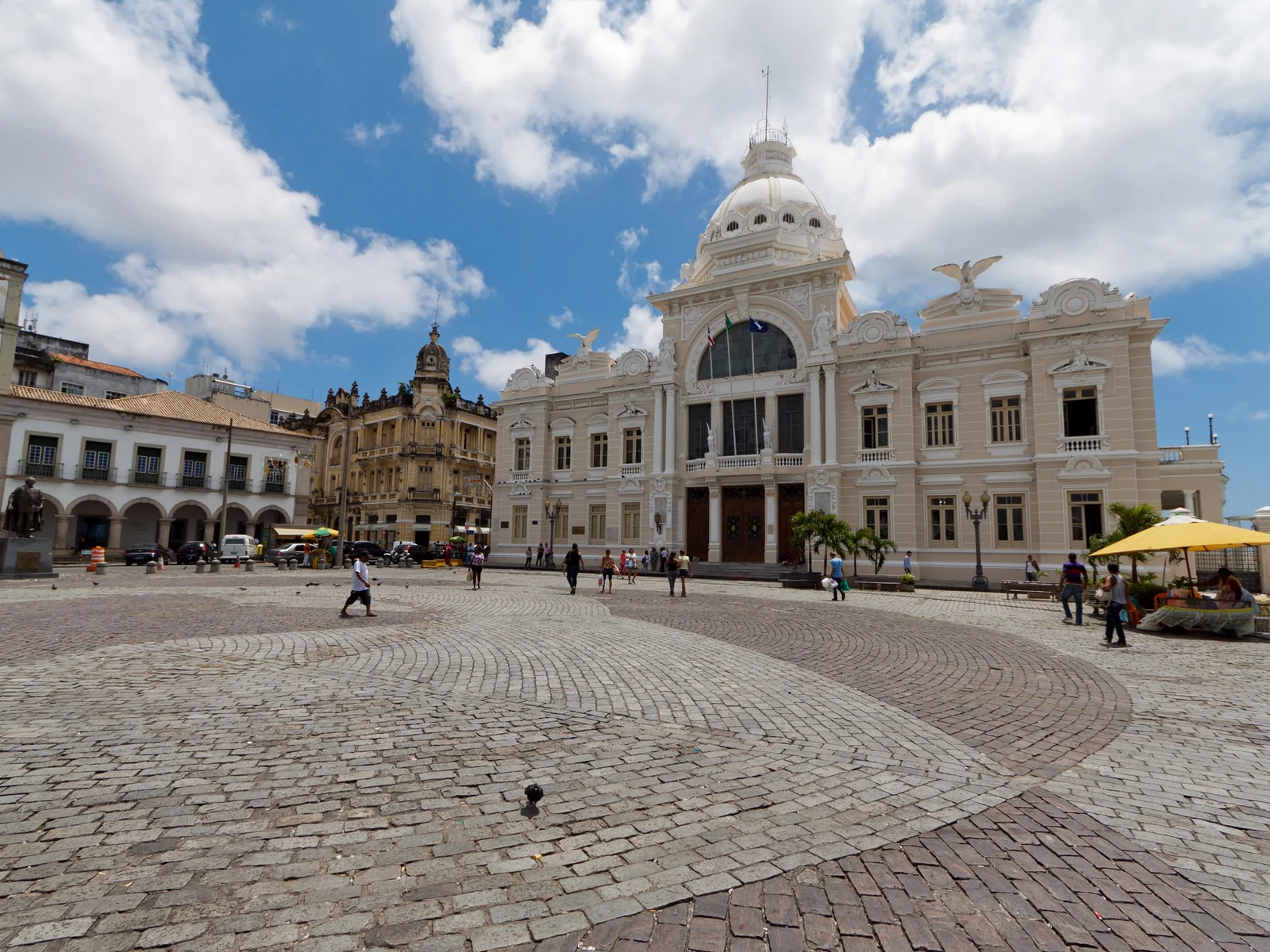
From the lift to the door is about 300 metres, four to five minutes: across the Praça Tomé de Sousa, past the Palácio Rio Branco and along Rua Chile, which the city calls Brazil's first street. For the night of 10 November 2026, the official site asked R$ 1,349 (about US$ 260); search engines showed anything from R$ 939 on a one-off deal to R$ 2,394 with breakfast and flexible cancellation. The Fera suits anyone who wants a five-star hotel with history, a rooftop pool facing the bay and a serious restaurant downstairs. Its weak point is the one every hotel at this level shares, the price, and the entry-level rooms are compact if you book the cheapest category.
Fasano Salvador, on the Praça Castro Alves
The Fasano occupies the Edifício A Tarde, a 1930 building put up as the headquarters of the A Tarde newspaper, which stayed there for 45 years. It is one of the clearest examples of Art Deco in the city, listed by Bahia's heritage institute, IPAC, and it is the group's first hotel in a listed building. The hotel opened in 2018, and the newspaper's masthead lettering was kept beside the Fasano name at the lobby entrance.
There are 11 floors and 70 rooms of 26 to 73 square metres, in six categories running from Superior to the sea-facing Deluxe Suite. Blue runs through the carpets, fabrics and ceramics; the original Carrara marble and verde alpi granite remain on walls and floors, and the old design of the room doors was preserved. Room 106 was the newspaper president's office and keeps its period parquet and jacaranda panelling.
The top floor holds the timber deck and the pool lined in blue Bahia granite, the Pool Bar, the gym and the spa, all facing the bay. The restaurant is Gero, the group's Italian house, led by chef Bahia Brito, who has spent more than three decades in Fasano kitchens; alongside the brand's classics, the Salvador menu carries moqueca, shrimp bobó and baked cocada. The hotel offers free electric-car charging to guests and Gero diners, a guided tour of the building's history with a historian, and offers such as four nights with the last one free.
Here too, the MICHELIN Guide awarded one Key in 2025 and kept it in 2026. On Google it was rated 4.8 from about 1,600 reviews. From the lift it is about 500 metres, six to seven minutes, along the full length of Rua Chile to the square named after the poet Castro Alves, whose statue faces the bay.
For the night of 10 November 2026, the lowest offer we found was R$ 1,920 (about US$ 371), and the big online travel agencies asked R$ 2,891 with free cancellation. It is the pick for travellers who want the service and cooking of a brand they know, a spa in the building and a rooftop pool. The thing to weigh is the calendar: the Praça Castro Alves is the finishing point of Carnival's Osmar circuit, which comes down Avenida Sete de Setembro with the trio trucks, so in February the square turns into a party and traffic around it is controlled. For some that is the best grandstand in town; for others, a reason to pick another week.
Villa Bahia, on the Largo do Cruzeiro de São Francisco
Villa Bahia occupies two colonial mansions from the 17th and 18th centuries, restored in the style of traditional pousadas, on the Largo do Cruzeiro de São Francisco, the little square with the stone cross that joins the Terreiro de Jesus to the Franciscan complex. It is the smallest and most intimate of the three hotels: 17 rooms of 18 to 40 square metres over three floors, some facing the baroque São Francisco ensemble, others the inner courtyards.
Each room honours a stop on Portugal's maritime expansion and carries its year next to the name: Ceuta, 1415; Cabo Verde, 1460; Goa, 1510, with a 19th-century Indian bed in solid wood; Macau, 1513; Nagasaki, 1543, on the third floor, with the hotel's largest terrace. Madagascar and Malaca, on the second floor, are among the largest rooms and look over the esplanade; São Tomé e Príncipe, on the third, is the smallest, made up for by a terrace over the neighbourhood's rooftops. Four-poster beds, antique furniture, wide wooden floorboards and high ceilings complete the picture. The pool sits in one of the garden courtyards, and a panoramic terrace looks across the coloured rooftops to the church towers.
The service follows the pousada model: a bar stocked with Bahian products, breakfast served at your table, staff who help with outings, and an airport transfer offered by the hotel itself. According to the rooms page, the building has a lift, and rooms have air conditioning and a safe. On Google it was rated 4.7 from about 380 reviews, and the night of 10 November 2026 showed at R$ 1,331 (about US$ 257).
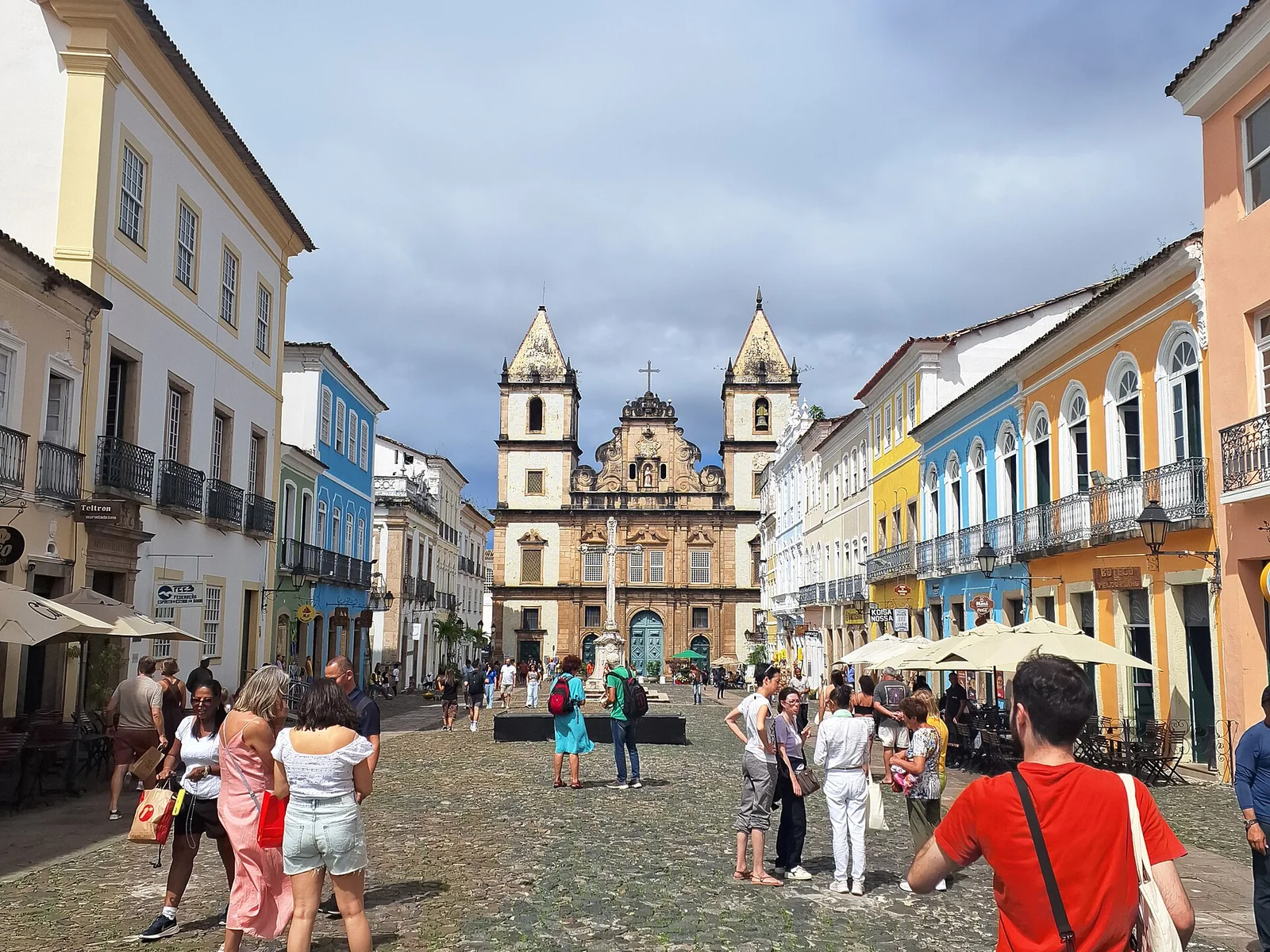
From the lift it is about 700 metres, roughly nine minutes, by way of the Praça da Sé and the Terreiro de Jesus; the address is inside the Pelourinho, about five minutes from the Largo do Pelourinho, rather than on its edge. Two useful notes. First, the Igreja de São Francisco, the gilded church across the square, has been closed since part of its ceiling collapsed on 5 February 2025, with reopening planned for 2029; the Igreja da Ordem Terceira de São Francisco next door, with its facade carved in sandstone, is open. Second, on Tuesday nights the Terça da Bênção fills the neighbourhood's squares with music, and Villa Bahia sits right in the middle of it. If you want that, it is the right address; if you sleep early, ask for a room facing the courtyard.
Via Avantgarde, four suites beside the lift
Via Avantgarde is not a hotel, and it is worth knowing that before you book. It is four private suites, each for two people, on the blocks around the upper door of the lift, booked only through Airbnb. There is no front desk, restaurant or pool; entry is by code or smart lock, the host is a Superhost, and you get a space of your own with a kitchen. In exchange, the nightly rate runs between a quarter and a third of the neighbouring hotels' for the same dates.
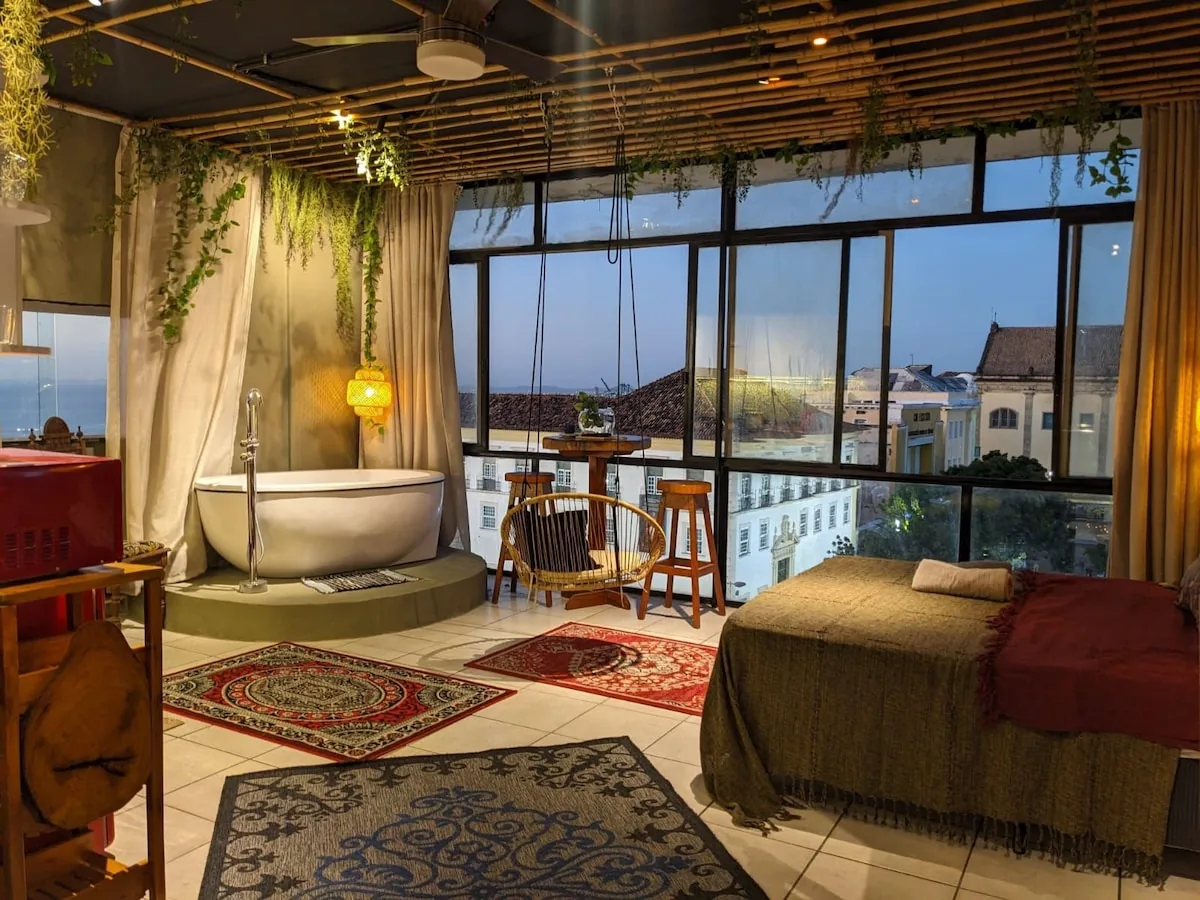
Penthouse Jacuzzi. A loft at the top of a building with a lift, with a bamboo ceiling, antique Bahian furniture and objects, a gourmet kitchen with a five-burner gas hob, a large fridge, a dining table, a desk, Wi-Fi and a speaker. From the bedroom window you see the top of the Elevador Lacerda with the bay behind it. The soaking tub for two sits in the loft itself. It was rated 4.82 on Airbnb from 185 reviews in September 2026, and a 17 to 19 November stay came to R$ 403 a night (about US$ 78).
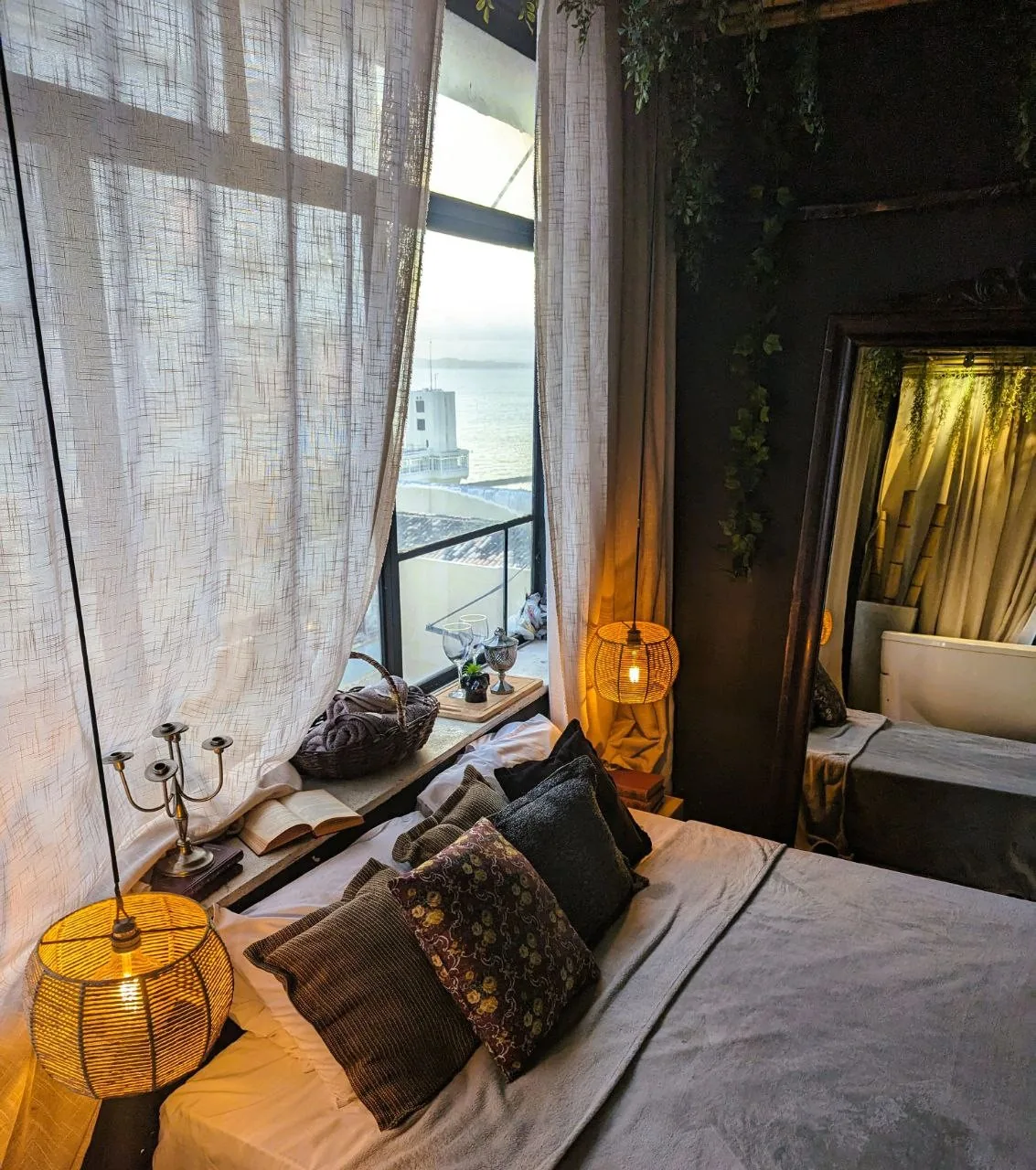
Elevator & Sea View. A large room with floor-to-ceiling windows facing the lift and the bay, with the tub against the glass in line with the sunset. It has a kitchen, air conditioning, keypad entry and paid parking in the building. Rated 4.78 from 187 reviews; R$ 435 a night (about US$ 84) for 17 to 19 November.
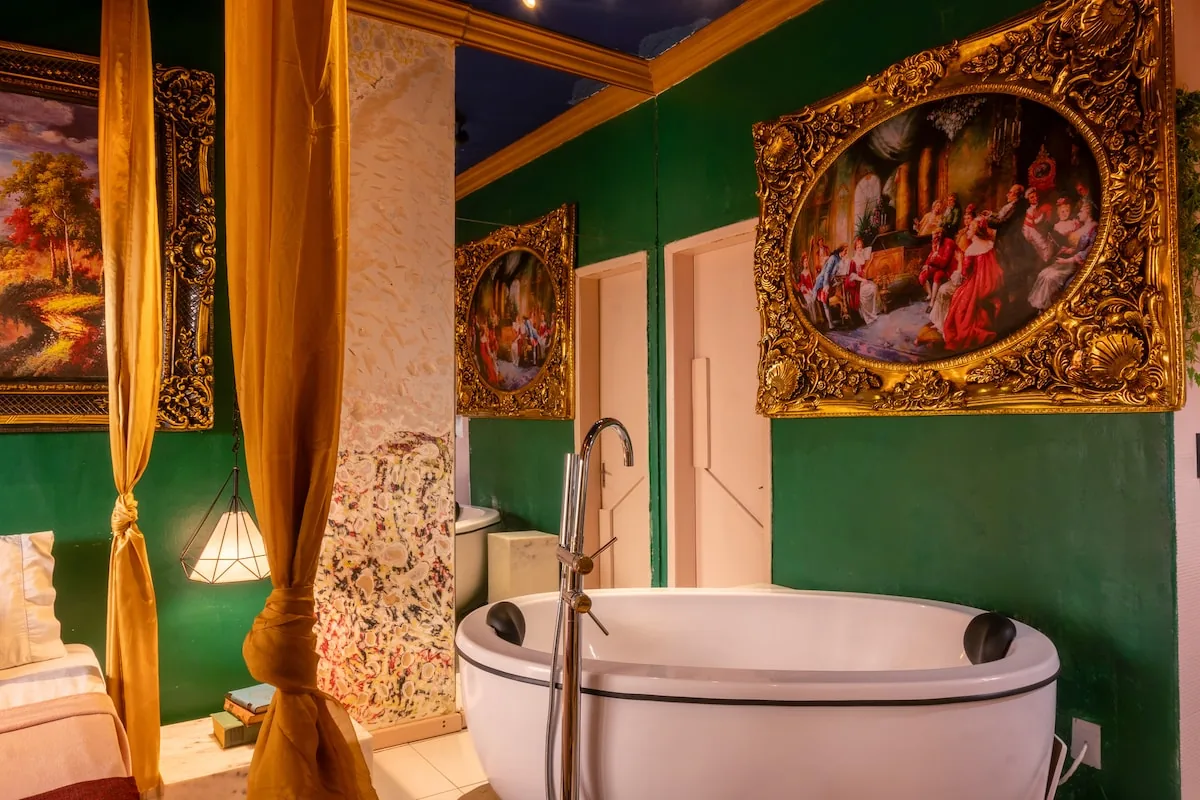
Historic Loft. A studio, with bed and tub in the same room, green walls, gilded frames and the lift a few metres from the door. It is the least expensive of the four: R$ 345 a night (about US$ 67) for 10 to 12 November. Rated 4.76 from 54 reviews.
Colonial Suite. A one-bedroom apartment with a contemporary finish, on the way from the lift to the Fasano, in a building with a lift. It has no tub. When we wrote this, it had no free dates until August 2027; cancellations happen, so the calendar is worth a look. Rated 4.75 from 40 reviews.
Worth knowing before you book: two suites are on the square, and their own listings warn that concerts and events there can be heard inside; there is no breakfast and no daily housekeeping; and on the dates we checked, the minimum stay was two nights. People who like to cook a moqueca with fish from the market, work at a desk with a view or simply never meet anyone in a corridor tend to prefer this format. People who want someone to bring a drink at eleven at night will be happier in one of the three hotels. All four suites are on our home page, with photos and amenities.
Which one, for which trip
Honeymoon or a special occasion. If the plan is a rooftop pool, a sunset drink and dinner without leaving the building, choose between the Fera Palace and the Fasano; the Fera keeps its terrace for guests, and the Fasano has a spa. If the plan is privacy, a tub and the sunset from your own window, the Penthouse and the Elevator & Sea View were set up for exactly that, and the host puts together a romance package on request. Our guide to romantic Salvador covers the rest of the trip.
History and architecture. The Fera, in the 1934 Palace, and the Fasano, in the 1930 newspaper building, are two of the city's finest Art Deco buildings, and you can see both on one walk: one stands at the start of Rua Chile, the other at the end. If you prefer colonial Brazil to Art Deco, Villa Bahia, with its mansions and courtyards, will suit you better.
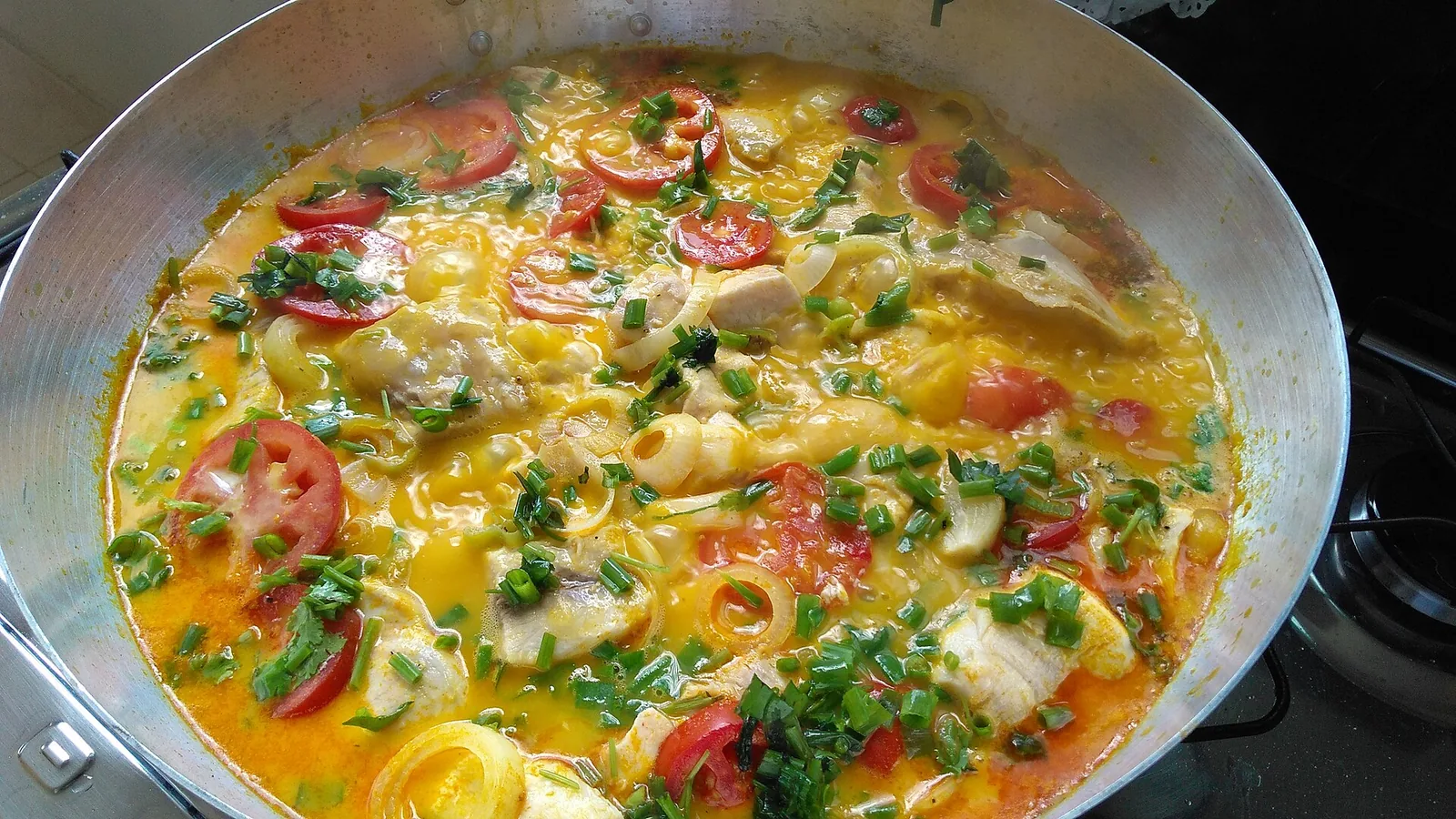
Eating well. A hotel with a restaurant solves dinner without planning: Arento at the Fera, Gero at the Fasano. In a suite the pleasure is different: fish, fruit and spices from the market cooked in your own kitchen, with the restaurants of the Pelourinho and Santo Antônio Além do Carmo on foot.
Long stays or remote work. Here the suites win comfortably: a full kitchen, a desk in the Penthouse, Wi-Fi and long stays allowed in the Penthouse and the Elevator & Sea View. Over 30 nights at November rates, the difference against any of the three hotels comes to more than R$ 25,000 (about US$ 4,800).
Families or groups. The suites sleep two each, so a family of four would need two. The Fera describes its 35-square-metre Executive room as suited to families, and all three hotels have larger categories; ask each about extra beds.
Work and events. For a business trip with meetings, the hotels have the facilities: the Fasano has a business centre with three offices and event spaces over the bay, and the Fera has event rooms in its 1934 building. A suite works well for one person on a laptop, but not for hosting a group.
Budget. If your ceiling is R$ 500 (about US$ 100) a night, the choice makes itself: on the dates we checked, only the suites came in under it.
What is within five minutes of each door
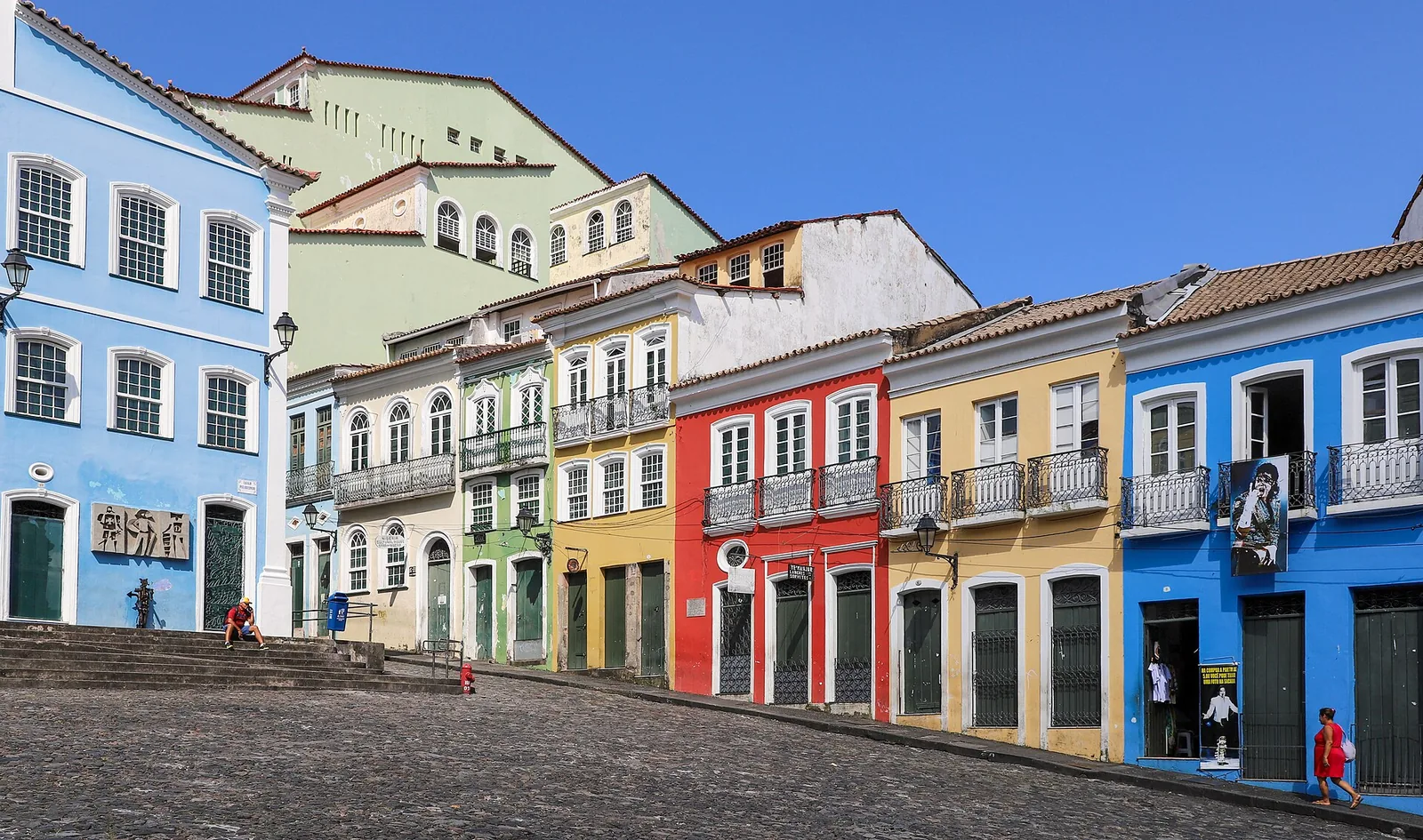
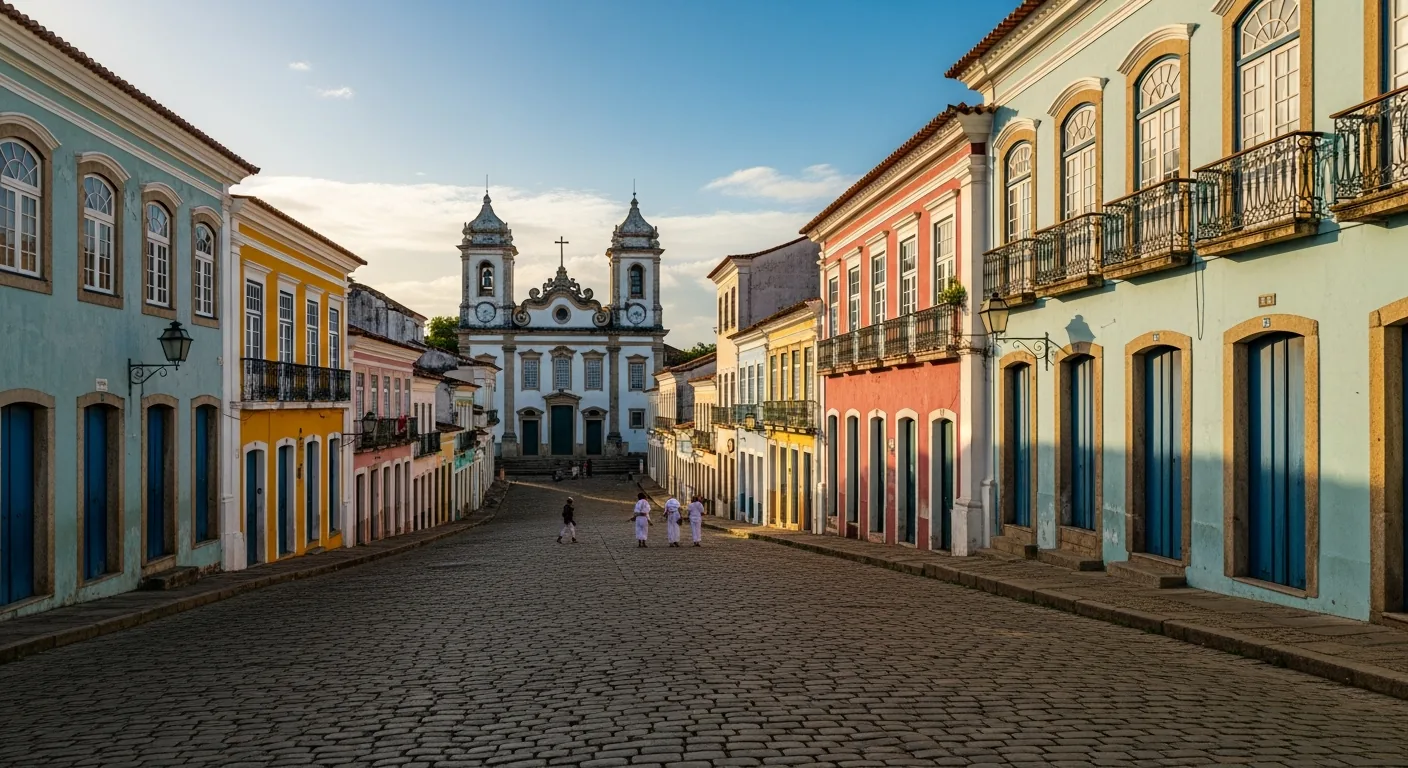
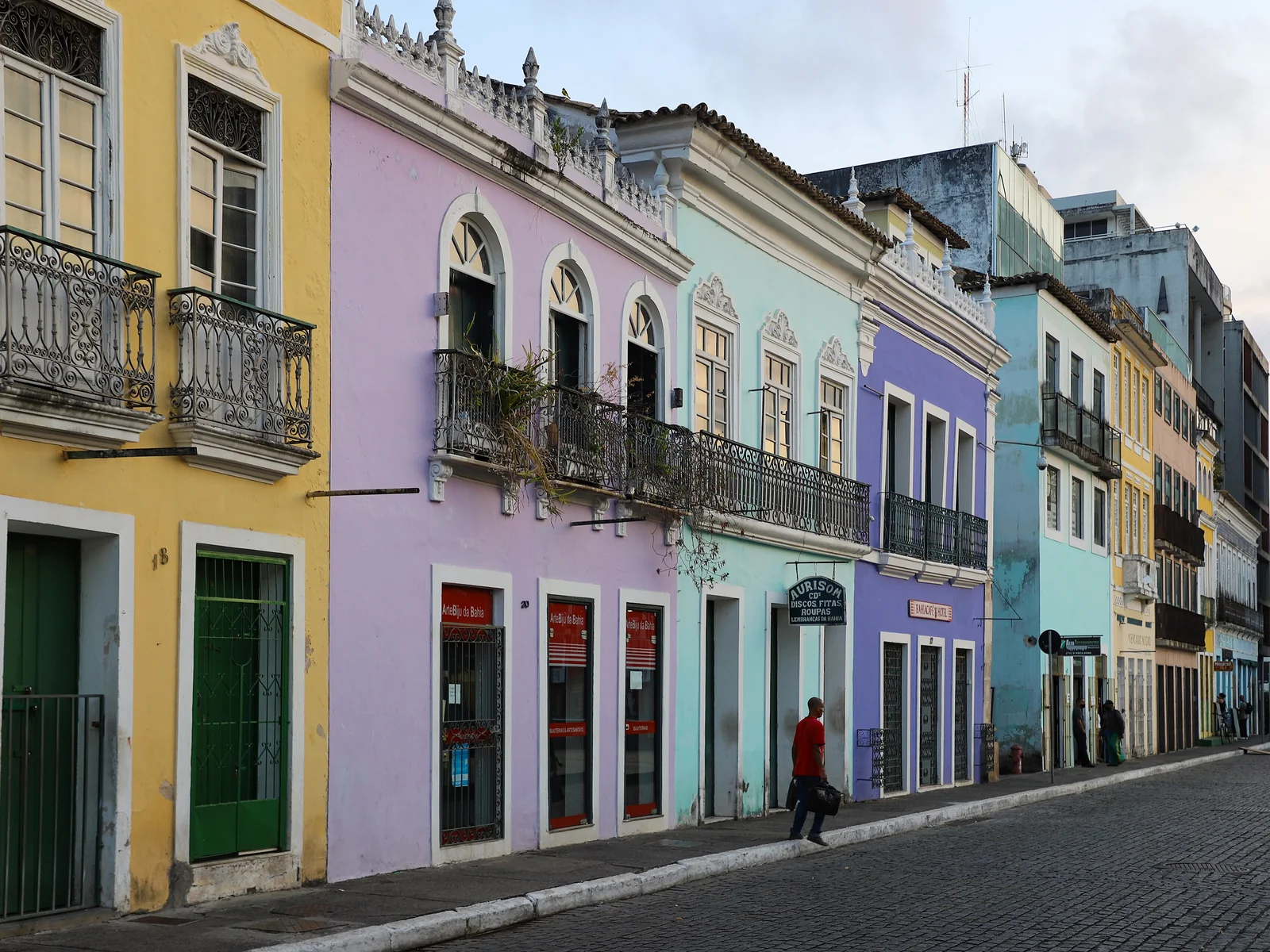
North of the lift, Rua da Misericórdia leads to the Praça da Sé and straight on to the Terreiro de Jesus, with the Catedral Basílica and the Afro-Brazilian Museum, MAFRO, in the old Faculty of Medicine building. Behind the cathedral, on the Praça Ramos de Queirós, the Casa do Carnaval opened in 2018 and tells the story of the festival with costumes, films and even a bloco dance lesson. Keep going and you reach the Largo do Cruzeiro de São Francisco and, downhill, the Largo do Pelourinho. Our Pelourinho guide lays that walk out.
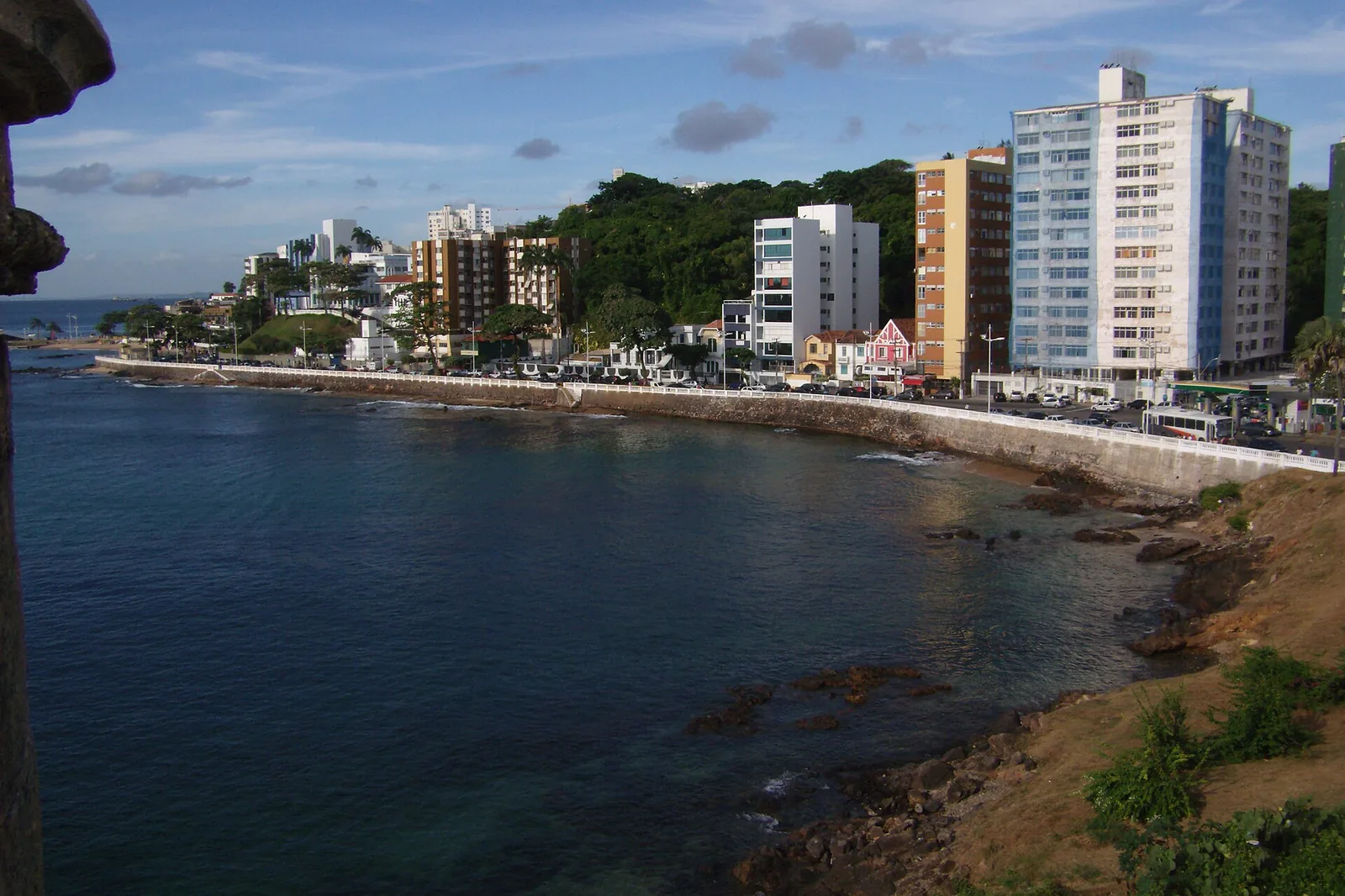
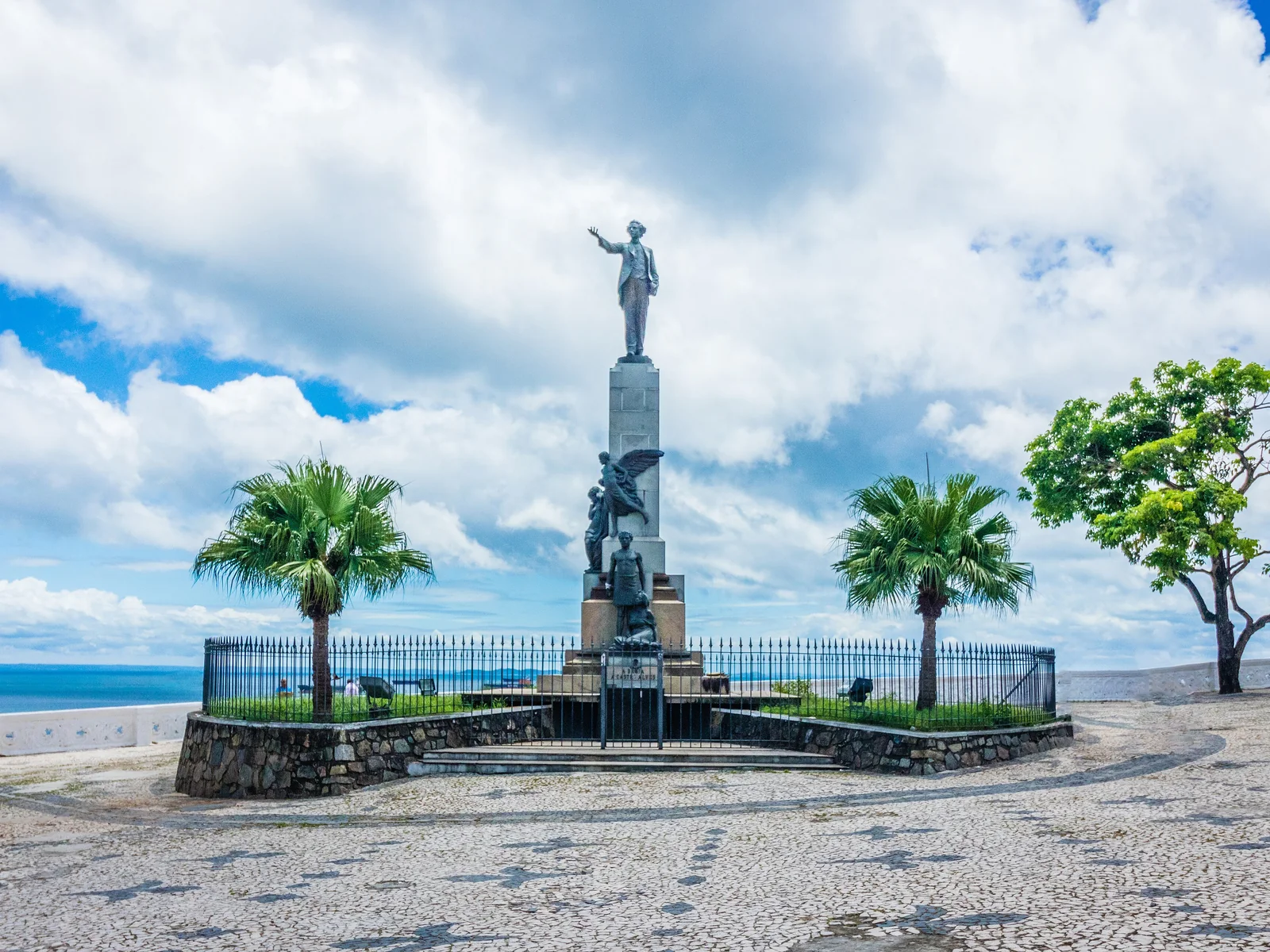
South of the lift, Rua Chile passes the Palácio Rio Branco and ends at the Praça Castro Alves, with the poet's statue and one of the widest views over the bay. On the Praça Tomé de Sousa itself, the lookout beside the lift is one of the easiest sunset spots in the city, and the Praça da Sé has another belvedere next door; our Salvador sunset guide compares the best of them.
The Catedral Basílica and the Ordem Terceira de São Francisco are under ten minutes from all four addresses, and the Igreja do Rosário dos Pretos, where the Terça da Bênção begins after evening mass, stands on the Largo do Pelourinho. Our guide to the churches of Salvador covers opening hours and what is closed. For museums, our museums guide notes that MAFRO opens on weekdays only and that the city-run museums are free on Wednesdays.
Down to the lower city: market, boats and music
The lift's lower door opens onto the Praça Cayru. Across it stands the Mercado Modelo, the old 1861 customs house, with more than 250 stalls of crafts, hammocks, berimbaus and cachaça, and two traditional restaurants upstairs, Maria de São Pedro and Camafeu de Oxóssi, with terraces over the bay. The market opens Monday to Saturday, 9 am to 7 pm, and Sunday, 9 am to 2 pm; our Mercado Modelo guide explains how to haggle.
Next door is the Terminal Náutico. The catamarans to Morro de São Paulo leave from here, a crossing of about two and a half hours, as do the launches to Mar Grande on Itaparica island, roughly every half hour and about 50 minutes each way. When you sleep near the lift, the first boat of the morning is a few minutes from your bed, and that is where the location pays for itself. On the same square, in the blue-tiled mansion at number 19, the Cidade da Música da Bahia opened in 2021 with four floors on Bahian music.
The Comércio empties when the offices close. Do the lower city by day and ride back up before the lift stops; after hours, go up by ride-hailing car, not by the ladeiras. Our guide to getting around Salvador shows how lift, boat, metro and ride-hailing fit together.
A full day from the lift's door
To feel what the location is worth, plan a day with no taxi at all. Start early on the Praça Tomé de Sousa, while the lookout is still empty and the bay has its flat morning light. At 9 am MAFRO opens on the Terreiro de Jesus on weekdays, and the Catedral Basílica across the square opens around the same time; the cathedral charged R$ 10 (about US$ 2) at the end of 2025. Around 11, head to the Casa do Carnaval behind it, open Tuesday to Sunday from 9 am to 5 pm, R$ 20 (about US$ 4), free on Wednesdays.
At lunchtime, ride the lift down and climb to one of the Mercado Modelo terraces facing the bay. In the afternoon, choose between the Cidade da Música, a minute from the lift's lower door, a launch to Mar Grande about 50 minutes away, or simply going back to your room in the worst of the heat, which only works when your room is five minutes away. In the late afternoon, return to the lift's lookout or the Praça Castro Alves for the sunset, and get there half an hour early. In the evening, eat in the Pelourinho, at Arento or at Gero, and if it is a Tuesday, follow the music of the Terça da Bênção.
That whole day fits into about three kilometres of walking and two lift rides. Staying out on the beaches, the same day takes two car journeys of 15 to 25 minutes each, and the sunset on the square usually gets left for another day. Our Salvador itinerary builds the rest of the trip around that first day.
At night: the way home
The everyday risk in the historic centre is opportunistic theft: a phone on a café table, an open bag in a crowd. Bahia's Military Police run a tourist-focused operation in the neighbourhood, with patrols on foot and on motorbikes, and the presence is strongest by day and on nights with cultural events. Between the four addresses, the axis of the Praça Tomé de Sousa, Rua Chile and the Praça Castro Alves is lit and busy in the early evening, as are the Praça da Sé and the Terreiro de Jesus.
The rule that works: move around the squares while there are people, and when the crowd thins, take a ride-hailing car, even for short distances. The steep ladeiras down to the lower city and empty side lanes are not night routes. On Tuesdays the Terça da Bênção keeps the neighbourhood awake later; on other nights the historic centre empties after dinner. Our guides Is Salvador safe? and Salvador at night have the detail.
One practical difference between the formats: the hotels have a 24-hour front desk, while the suites have code entry with nobody to open the door. If you stay in a suite, keep the code on your phone and on paper, and arrange any late arrival with the host through Airbnb.
From the airport to the door
The airport is about 28 kilometres from the historic centre, and the ride takes 35 to 50 minutes outside rush hour. By ride-hailing app, the fare to the Cidade Alta ran R$ 60 to 110 (about US$ 12 to 21) in 2026 depending on the time; the official taxi desk in arrivals charges a fixed price, roughly R$ 100 to 200 (about US$ 19 to 39). To save money, take the metro: Line 2 ends at Aeroporto station, four minutes from the terminal by free shuttle bus, and a ride costs R$ 4.10 (about US$ 0.80), changing to Line 1 for the centre. With luggage, though, the last stretch from Lapa station up to the Cidade Alta calls for a car anyway.
Villa Bahia offers an airport transfer; at the Fera and the Fasano, ask when booking whether the hotel arranges one and what it costs. At the suites you arrive on your own, with the address and entry instructions Airbnb releases after booking. If you are driving: the Elevator & Sea View has paid parking in the building, the Penthouse points to paid parking nearby, and the Fasano has electric-car charging. Our airport guide compares every option.
Arriving with luggage and getting around at an easy pace
The Cidade Alta is as tiring as it is beautiful. The ground is uneven stone, pavements are narrow, the ladeiras are steep and dropped kerbs are rare. The Praça Tomé de Sousa is flat and well paved, and Rua da Misericórdia rises gently for about 400 metres to the Praça da Sé and the Terreiro de Jesus. The Elevador Lacerda itself has level boarding at both ends, which makes it one of the easiest stretches of the centre for anyone with limited mobility.
Inside the buildings, the difference matters. The two five-stars are tall buildings with lifts, and Villa Bahia's rooms page also lists a lift. Among the Via Avantgarde suites, Airbnb shows a lift in the Penthouse's building and the Colonial Suite's; for the Elevator & Sea View and the Loft, ask the host before booking if stairs are a problem. With a big suitcase, ask the driver to stop as close to the door as possible and expect a few metres of cobbles at the end.
If you use a wheelchair or walk with a cane, our accessible Salvador guide gathers the places with documented access, and the city publishes an official map of venues with ramps, lifts and adapted bathrooms.
When to go
Salvador is warm all year, with highs of 27 to 31 °C and a sea at 25 to 28 °C, so the real questions are rain, crowds and price. The driest, sunniest stretch runs from September to March, with the least rain in December and January. It rains more from April to July, peaking in May and June, but mostly in short, heavy showers, often in the late afternoon or at night.
For a stay near the lift, that has a simple consequence: the bay view and the sunset at the lookout are most reliable from September to March, and the lowest prices turn up in the rainy months, outside holidays. Prices peak at New Year, Carnival and long holiday weekends. November, outside the week of the 20 November holiday, tends to combine dry weather with low-season rates, which is why we used it as the reference month for the prices in this guide. Our guide to the best time to visit goes month by month.
Carnival, New Year and the most expensive weeks
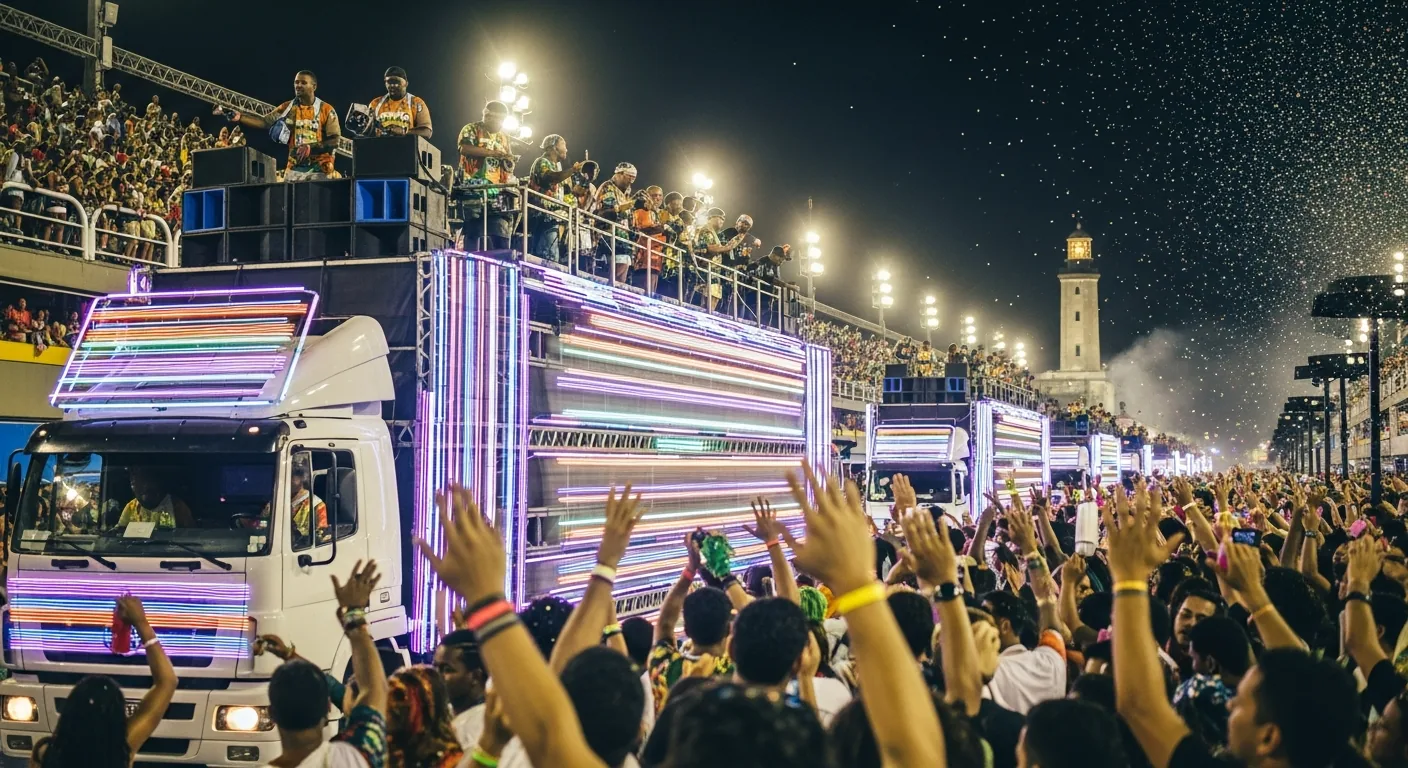
Carnival 2027 runs for 13 days from Friday 29 January, with the main days from Thursday 4 to Tuesday 9 February, ending on Ash Wednesday. Of the three circuits, the Dodô, from Barra to Ondina, is far from here. The Batatinha takes place in the Pelourinho itself, with no trio trucks and music on the squares, and the Osmar comes down Avenida Sete de Setembro to the Praça Castro Alves, the Fasano's square. In 2025 the lift ran 24 hours a day during the festival.
That has two effects. The first is price: the Historic Loft, R$ 345 a night in November, showed at R$ 1,075 a night (about US$ 207) for Carnival 2027, and minimum stays of five to seven nights are common across the city that week. The second is logistics: with a circuit at the door, traffic around it is controlled on parade days, so reaching the Fasano or Rua Chile by car takes planning. If you want trio-truck Carnival close to home, you are in the right place, and the same goes for the Pelourinho's Carnival without trucks. Our Carnival guide covers abadás, camarotes and the calendar.
At New Year demand jumps again: the Penthouse showed at about R$ 617 a night (about US$ 119) from 30 December to 2 January, and the Fera advertises its own New Year's Eve party. The Iemanjá festival on 2 February happens in Rio Vermelho, far from here, but fills the whole city. Our Bahia festival calendar lists the 2027 dates, and our guide to New Year and Iemanjá explains both festivals.
Booking without surprises
For the hotels, compare the official site with the agencies. On the night we checked, the Fera showed R$ 1,349 on its official site, while a big agency asked R$ 1,832 (about US$ 354) for the entry-level room; luxury hotels often keep good terms for direct bookings. Read carefully whether breakfast is included and until when cancellation is free: at the same agency and for the same room, the gap between the plainest rate and the one with breakfast and flexible cancellation topped R$ 500 (about US$ 97).
For the Via Avantgarde suites, booking is through Airbnb only, which shows the total with fees before you confirm. There are two rates: the cheaper non-refundable one and a refundable one, which for the Loft cost R$ 750 for two nights against R$ 690. When we checked, Airbnb offered the payment in six interest-free instalments. Messages with the host also go through the platform, and that is where you ask about arrival times, luggage or the romance package put together on request. Our booking page links straight to each suite.
And book early for the big dates. New Year and Carnival sell out all four addresses months ahead, and the Colonial Suite already had no free dates until August 2027 when we wrote this.
Other addresses nearby
If none of the four fits, there are other options on foot. Casa do Amarelindo, at Rua das Portas do Carmo 6, is about 725 metres from the lift, practically level with Villa Bahia, and has a pool, a restaurant and a bar. The Pelourinho Boutique Hotel, part of the OH Hotéis group, at Ladeira do Carmo 23, is about a kilometre away, past the Largo do Pelourinho. Aram Yamí, with six suites, is in Santo Antônio Além do Carmo, about 1.7 kilometres away. And a warning if you are using older guidebooks: the Pestana Convento do Carmo closed in April 2020 and was still closed in 2026. If your question is which neighbourhood rather than which street, our guide to where to stay in Salvador compares the areas of the city.
Frequently asked questions
What is the closest hotel to the Elevador Lacerda?
Among full-service hotels with a front desk, the Fera Palace Hotel at Rua Chile 20, about 300 metres from the lift's upper door, four to five minutes on foot. The Fasano is about 500 metres away and Villa Bahia about 700. The Via Avantgarde suites are closer still, two to six minutes, but they are private apartments booked through Airbnb, with no front desk.
Do you have to pay to ride the Elevador Lacerda?
In May 2026 it was free for residents and visitors. The R$ 1 fare the city announced for after the refurbishment, completed in February 2025, was not being charged. Since that can change, check on the day; if the fare returns, the announced amount is small, about 20 US cents.
What time does the Elevador Lacerda close?
It runs 6.30 am to 9.30 pm Monday to Friday. On weekends and holidays it opens at 7 am and, according to the city's historic-centre portal, closes at 9.30 pm on Saturdays and 9 pm on Sundays and holidays. During Carnival 2025 it ran 24 hours. After closing time, the way between the two levels of the city is a ride-hailing car.
How do I get from the Elevador Lacerda to the Mercado Modelo?
By the lift: its lower door opens onto the Praça Cayru, right opposite the Mercado Modelo, and the ride takes about 30 seconds. From the Fera, the Fasano or the suites, the whole trip takes five to ten minutes including the walk to the lift. The Terminal Náutico, where the boats leave for Morro de São Paulo and Itaparica, is next to the market.
Can you walk from the Fasano to the Pelourinho?
Yes. From the Praça Castro Alves to the Terreiro de Jesus is about 800 metres, roughly 11 minutes, by Rua Chile, the Praça Tomé de Sousa and the Praça da Sé; to the Largo do Pelourinho, about a kilometre. The way is stone-paved with gentle climbs. At night, except on Tuesdays and event nights, come back by ride-hailing car.
Do the hotels near the Elevador Lacerda have pools?
All three hotels in this guide do. The Fera Palace has a rooftop infinity pool for guests only; the Fasano, a rooftop pool lined in blue Bahia granite; Villa Bahia, a pool in a garden courtyard. The Via Avantgarde suites have no pool, but three of the four have a soaking tub in the suite.
How much does a night near the Elevador Lacerda cost?
For a night in November 2026, the three hotels showed between R$ 1,331 and R$ 1,920 for two people (about US$ 257 to 371), and the Via Avantgarde suites between R$ 345 and R$ 435 a night (about US$ 67 to 84) on two-night stays. At New Year and Carnival prices climb steeply: the Historic Loft went from R$ 345 to R$ 1,075 a night for Carnival 2027.
Is Via Avantgarde a hotel?
No. It is four private suites for two people near the lift's upper door, booked only through Airbnb. Entry is by code or smart lock; there is no front desk, breakfast or daily housekeeping, and each suite has a kitchen. The host is a Superhost, and the four suites had more than 460 reviews between them in September 2026.
Is it safe to walk between these addresses at night?
In the early evening, the axis of the Praça Tomé de Sousa, Rua Chile and the Praça Castro Alves, plus the Praça da Sé and the Terreiro de Jesus, are lit, busy and patrolled by tourist police. Late at night, and on any empty street, take a ride-hailing car even for short hops, and keep your phone off the table. The ladeiras down to the lower city are not night routes.
Is it worth staying near the Elevador Lacerda for Carnival?
It depends on the Carnival you want. The Osmar circuit ends at the Praça Castro Alves and the Batatinha circuit runs through the Pelourinho, so the area sits in the middle of the festival, with controlled traffic and much higher rates. If you want the Barra–Ondina circuit, staying in the Cidade Alta means a daily car ride there.
Sources
- Fera Palace Hotel, official site: history, rooms, rooftop, restaurant and awards (checked 26 Sep 2026).
- Fasano Salvador, official site: building, 70 rooms, rooftop, Gero and offers.
- Villa Bahia, official site and rooms page.
- Bahia Econômica: 2026 MICHELIN Keys in Bahia (18 Sep 2026, in Portuguese).
- CNN Brasil: the Fasano Salvador in its 1930 building (Dec 2023, in Portuguese).
- CNN Brasil: Fera Palace Hotel (Feb 2025, in Portuguese).
- Hotelier News: the Fera Palace building turns 90 (Jun 2024, in Portuguese).
- Bahia Econômica: the Elevador Lacerda stays free (15 May 2026, in Portuguese).
- iBahia: the Elevador Lacerda reopens (26 Feb 2025, in Portuguese).
- City of Salvador, Pelourinho Dia e Noite: lift opening hours.
- Panrotas: Pestana Convento do Carmo closes (Apr 2020, in Portuguese).
- The four suites' Airbnb pages (ratings, amenities and prices), checked 26 and 27 Sep 2026; hotel prices from a hotel search engine, checked 27 Sep 2026. Currency conversions at the European Central Bank rate of 25 Sep 2026 (US$ 1 = R$ 5.18).
Salvador, in images
Photographs of the neighborhood, restaurant, and beach featured in this guide, with credit to each photographer.
Ready to discover Salvador?
Book one of the four Via Avantgarde suites in the Pelourinho — and receive the complete guides with recommendations for your stay.