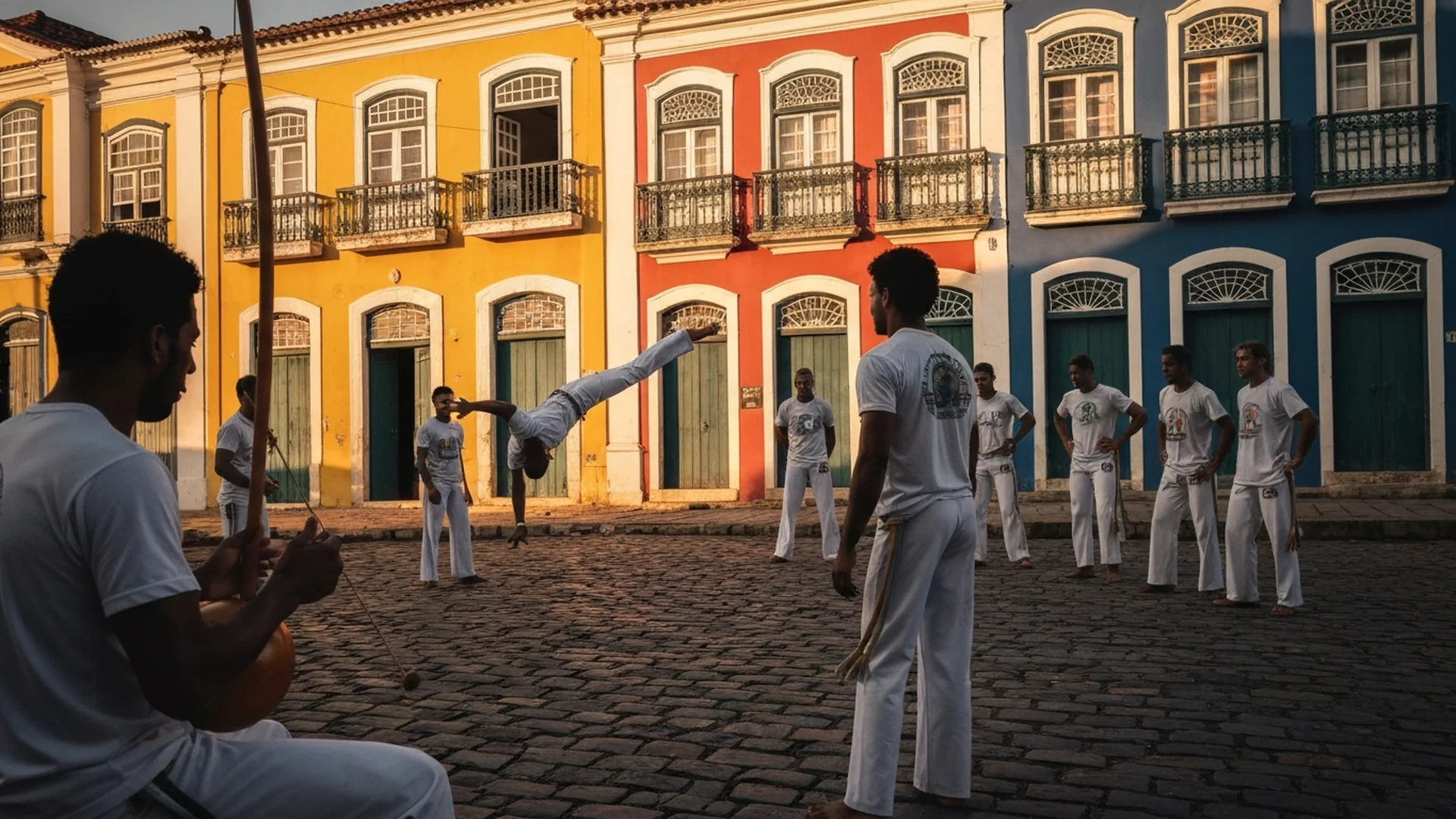
Capoeira Class with a Bahian mestre in the heart of the Pelourinho
Ninety minutes with a Bahian mestre — live berimbau, ginga, esquiva and the roda in the courtyard. The art Brazil gave the world, taught where it was born.
The experience
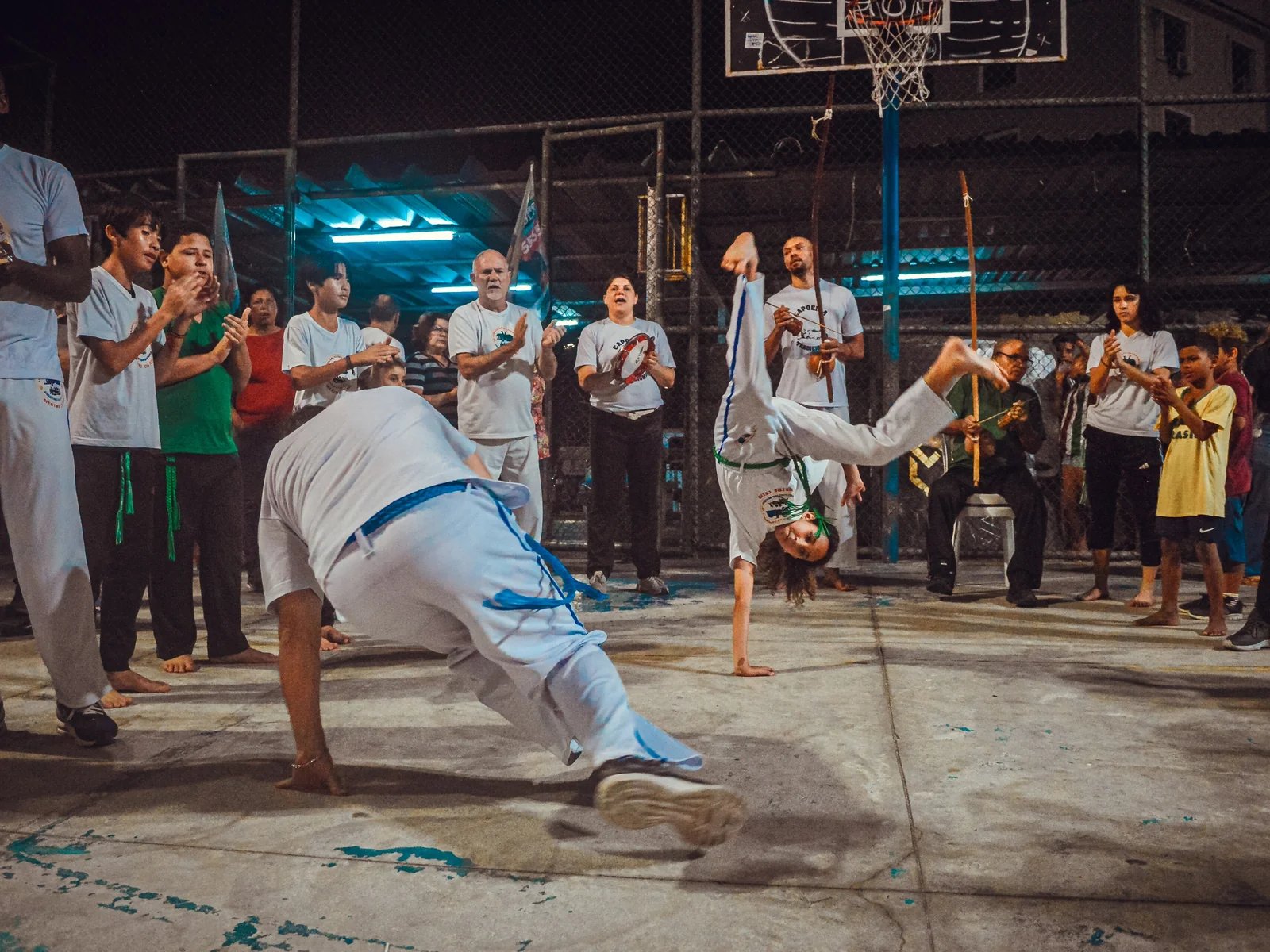
A Bahian mestre comes to the suite or receives you in a partner courtyard a few steps from the Largo do Pelourinho. The class opens with the history of capoeira — what came from the sugar plantations, what came from the terreiros, what Bimba and Pastinha codified in Salvador. Then the berimbau is tuned and played live: you hear the toques of Angola and São Bento Grande, try the pandeiro and the atabaque, and learn the founding movements — ginga, esquiva, au, meia-lua. The class closes with a small roda: you step into the game with the mestre as your partner, and leave with your body open and the sense of having touched one of Bahia's roots.
Um mestre baiano vem até a suíte ou recebe vocês em um pátio parceiro a poucos passos do Largo do Pelourinho. A aula começa com a história da capoeira — o que veio dos engenhos, o que veio dos terreiros, o que Bimba e Pastinha codificaram em Salvador. Em seguida, o berimbau é afinado e tocado ao vivo: vocês ouvem os toques de Angola e de São Bento Grande, experimentam o pandeiro e o atabaque, e aprendem os movimentos fundadores — ginga, esquiva, au, meia-lua. A aula fecha com uma pequena roda: vocês entram no jogo, com o mestre como parceiro, e saem com o corpo aberto e a sensação de ter tocado uma das raízes da Bahia.
- Certified Bahian mestre
- Berimbau, pandeiro and atabaque played live
- History of capoeira regional and capoeira angola
- Hands-on class: ginga, esquiva, au, meia-lua
- Closing roda with the mestre
- Open to beginners · ages 8 and up
- Class in Portuguese, English or Spanish
A setting
for the night
Every experience is put together with the same care as the suites — flowers, light, and details that turn a night into something to remember.
Capoeira in Salvador, the root of the root
The essentials in 30 seconds
Capoeira is, all at once, a martial art, a dance, a game, and a ritual — an Afro-Brazilian creation born in Bahia between the 16th and 19th centuries, banned by police from 1890 to 1937, and today a UNESCO Intangible Cultural Heritage of Humanity (since 2014). Two great schools exist: Capoeira Angola, slower and more theatrical, and Capoeira Regional, created by Mestre Bimba in Salvador in 1928 — faster and more athletic. Everything turns on a single instrument: the berimbau. The roda is a closed circle, and whoever steps inside plays — not fights. The Pelourinho is the world capital of capoeira and the most authentic place on the planet to begin.
What capoeira is (and what it is not)
Capoeira is hard to define in a single word because it slips out of every category. It is a martial art — strikes, dodges, takedowns — but the goal is never to knock the opponent out, it's to charm or fool them. It is a dance — fluid, rhythmic, in sync with live music — but with combat technique behind every movement. It is a game — two players answer each other inside the circle, read each other's bodies, smile, hold a conversation — but a physical conversation that can end with someone on the ground. And it is a ritual — the roda has hierarchy, order, an opening and a closing, and the mestre conducts it the way a maestro conducts an orchestra.
What it is not: it isn't wrestling, it isn't break-dance, it isn't choreography. Every roda is improvised, every game is unique, and what looks like rehearsed choreography is in fact two bodies reading each other in real time, in the tempo the berimbau dictates.
Where it came from
The short version: capoeira was created by enslaved Africans on the sugar plantations of the Recôncavo Baiano and in Salvador, across the 16th to 19th centuries. Brought above all from West-Central Africa — Angola, Congo, Benguela — the enslaved blended ancestral ritual dances (the n'golo, the zebra dance of the Mucupe people in southern Angola, is one of the most-cited roots) with combat techniques, and disguised the fight as a dance to escape the masters' and police's repression. Music — berimbau, hand-claps, song — entered as camouflage: it looked like a party, it was training.
After Abolition in 1888, capoeira was seen as a threat by the urban elite. In 1890, the first Penal Code of the Republic criminalized the practice — anyone caught playing capoeira went to jail, and capoeiristas circulated through the streets of Salvador, Recife and Rio as malandros and outlaws. For nearly fifty years capoeira was clandestine. Whoever trained, trained in family homes, in candomblé terreiros, in backyards. The berimbau replaced the drum so that, if police arrived, capoeira could turn into "samba de roda" and no one was arrested.
The turning point came in Salvador. In 1932, Mestre Bimba (Manoel dos Reis Machado, 1899-1974) opened the first Centro de Cultura Física e Capoeira Regional in the Engenho Velho de Brotas neighbourhood — academy classes, monthly fees, uniformed students, an unprecedented structure for a practice that until then had been criminalized. In 1937, after a demonstration for President Getúlio Vargas at the Palácio Rio Branco in Salvador, capoeira was decriminalized. Bimba codified a teaching method, created new sequences, and founded what is now called Capoeira Regional — faster, athletic, oriented to martial efficiency.
In parallel, Mestre Pastinha (Vicente Ferreira Pastinha, 1889-1981) was the great guardian of the traditional form. In 1942 he opened the Centro Esportivo de Capoeira Angola in the Pelourinho, defending the older capoeira — slower, ritualistic, low to the ground, full of humour and malícia. It is the lineage we now call Capoeira Angola.
The two mestres lived and taught in Salvador. Their lineages — Filhos de Bimba, Capoeira Angola Pastinha — crossed the 20th century and stand at the origin of practically every capoeira group in the world today. In 2014, UNESCO declared the roda de capoeira an Intangible Cultural Heritage of Humanity.
Regional, Angola, and contemporary
If you've never seen capoeira, you'll hear about two schools. The differences are real and beautiful to watch:
- Capoeira Angola — the older form, codified by Pastinha. Slow game, low, close to the ground, full of theatricality, malícia, feint. Players answer each other like a chess conversation. Slower-tempo music in the Angola toque, with the deep gunga berimbau leading. The form that most preserves the ritual character and the game as conversation.
- Capoeira Regional — codified by Bimba from 1928 onward. Faster, taller, with pre-trained attack-and-defence sequences, spectacular spinning kicks (armada, meia-lua, queixada), jumps. Music in São Bento Grande Regional, at accelerated tempo. The most athletic form, and the one most often seen in performances and films.
- Capoeira Contemporânea — a fusion of the two that emerged in the 1970s-80s and is today practised in most groups across Brazil and the world. It uses the pedagogical structure of Regional and the low game of Angola, without binding itself strictly to either.
In your class, the mestre will explain the difference and teach fundamentals common to all three. Then, depending on time and your interest, he can go deeper into one branch.
The berimbau and the other instruments
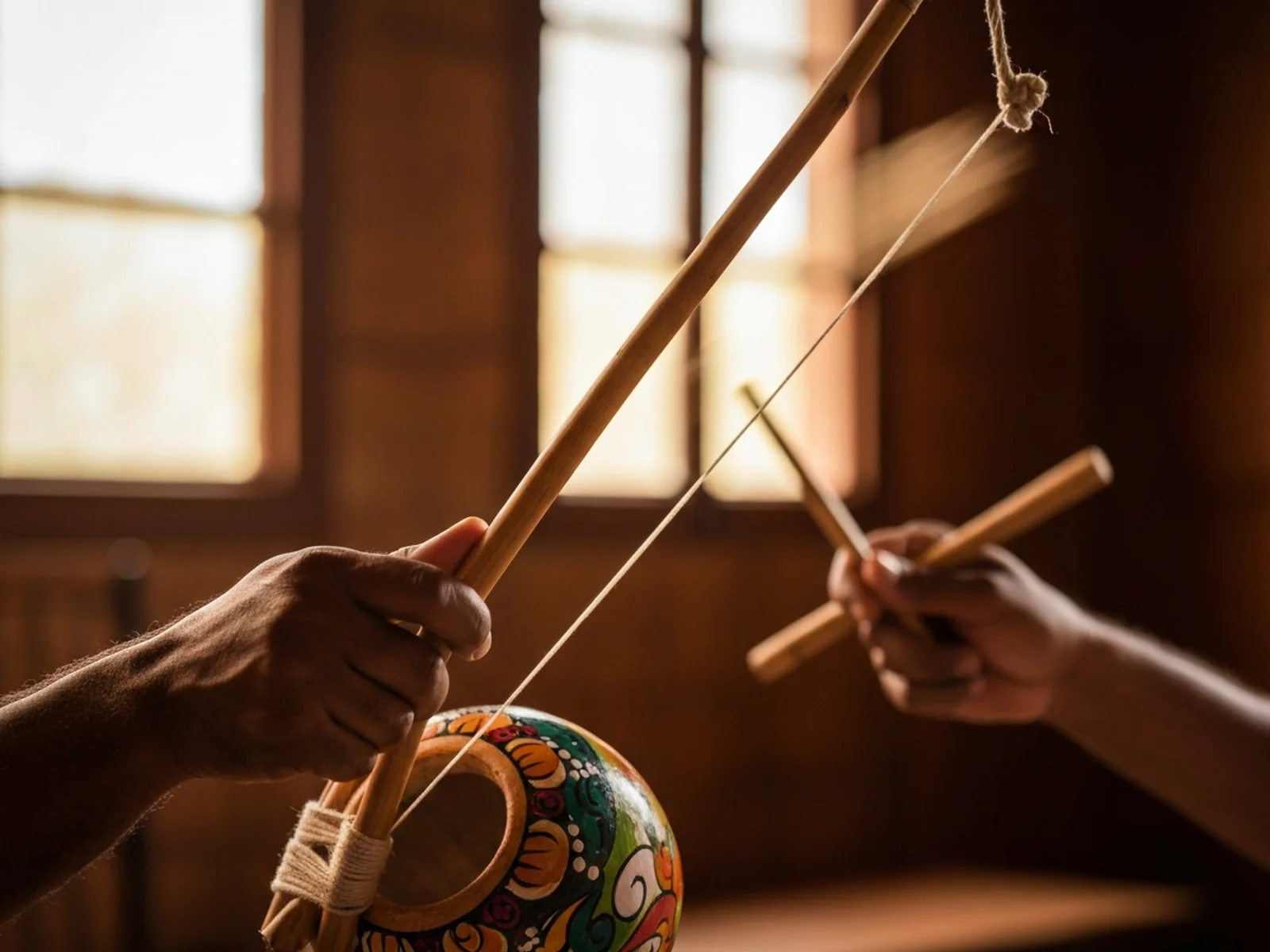
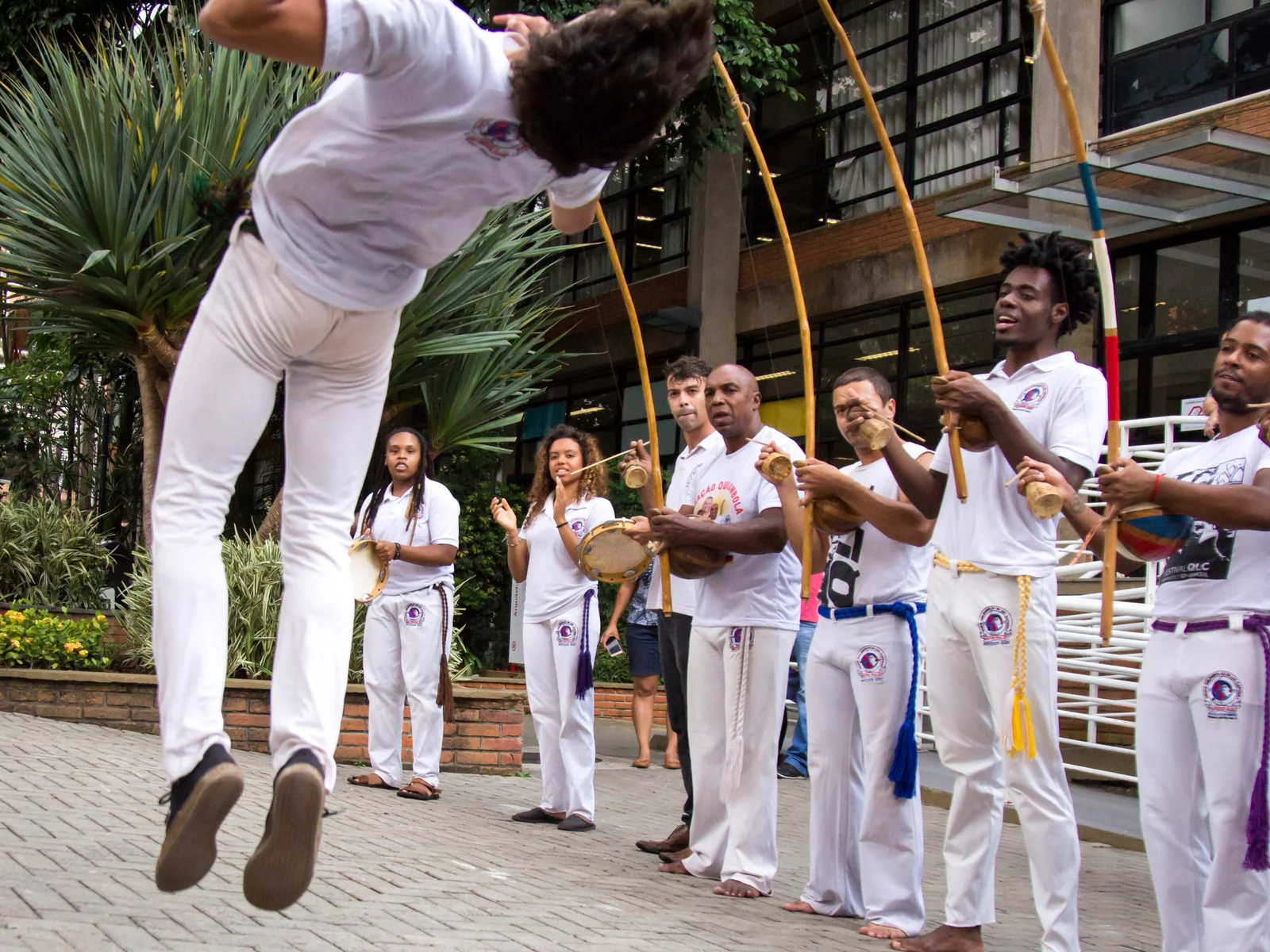
The berimbau is the heart of capoeira. Without berimbau, no roda — and whoever commands the berimbau commands the game: change the toque, the game changes. It is a single-string musical bow (the arame, usually steel wire from a recycled tyre), with a cabaça (a hollow dried gourd) attached at the base, acting as resonator. The musician holds a coin (dobrão) or stone against the string to alter the pitch, strikes the string with a vaqueta (bamboo or wooden stick) in the right hand, and at the same time holds a caxixi (woven straw shaker) that marks the off-beat.
There are three berimbau sizes in the classical orchestra:
- Gunga (or berra-boi) — the largest and lowest; commands the roda. Whoever plays the gunga decides when it begins, when it stops, who plays, who leaves.
- Médio — the middle one; lays the rhythmic base in harmony with the gunga.
- Viola — the smallest and highest; improvises over the other two, the "soloist" of the orchestra.
Alongside the three berimbaus, the orchestra is completed by the pandeiro, the atabaque (wooden hand drum), the agogô (double metal bell) and the reco-reco (scraped cylinder). In smaller rodas, one berimbau and one pandeiro suffice. Each combination of instruments plays a different toque — Angola, São Bento Grande, São Bento Pequeno, Iuna, Cavalaria — and each toque calls for a different kind of game. Learning to hear the toques is learning to read the roda.
The roda — how it works
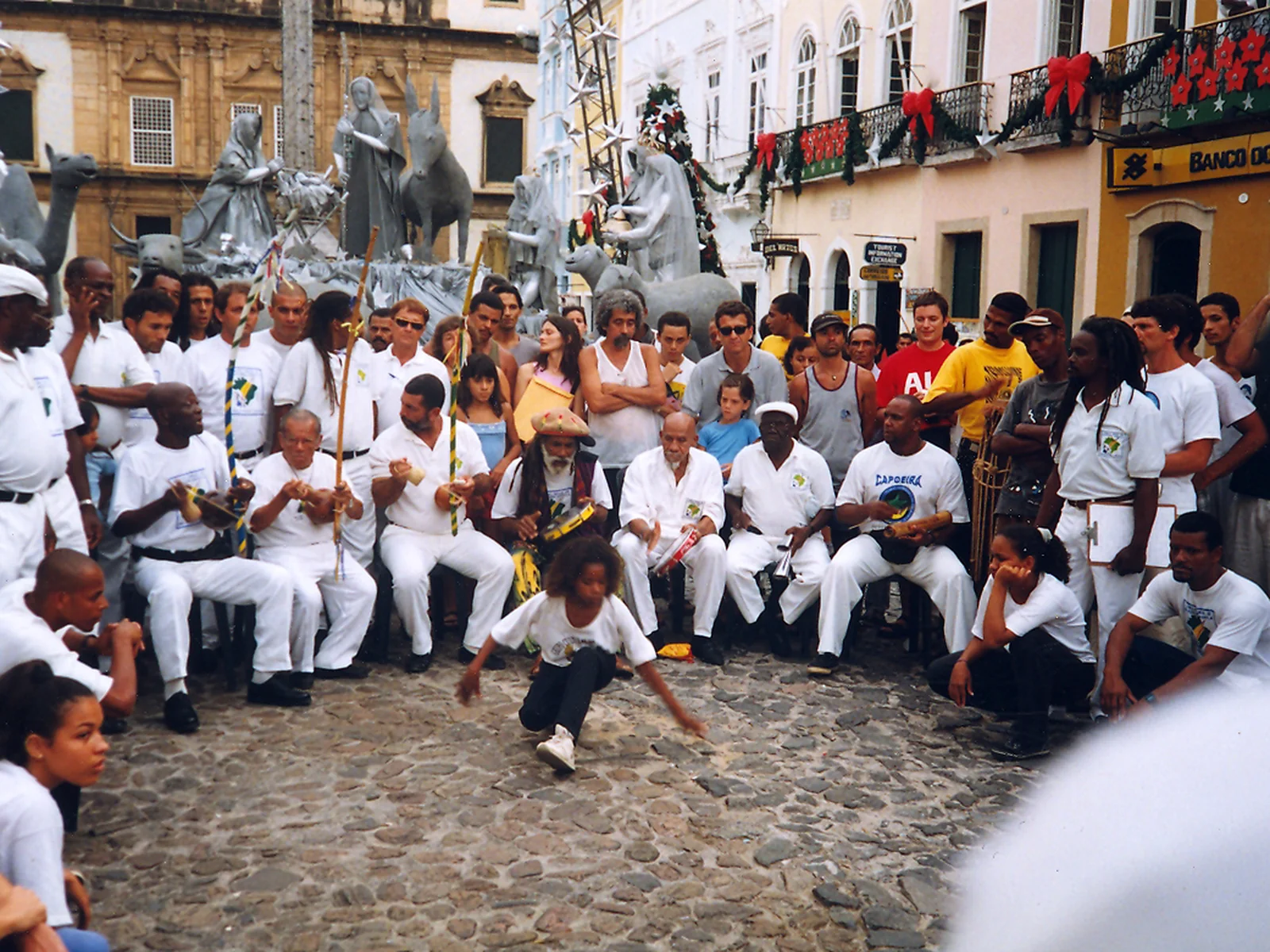
The roda is a closed circle of people. At the top of the roda are the instruments — berimbaus on one side, pandeiros and atabaque on the other. The roda begins with the chamado: the mestre plays the gunga alone for a few seconds, drawing the other instruments in one by one. When the orchestra is complete, the ladainhas begin — long, ancient songs in which the mestre or one of the more experienced capoeiristas sings a verse of greeting to the ancestors. Then come the chula and the corrido — shorter songs, in call-and-response, where the whole roda sings together and claps.
The first two players position themselves at the foot of the gunga berimbau, crouched, hands on the ground. When the mestre gives the signal — a turn in the toque, a smile, a nod — they enter the roda with an au de entrada (a cartwheel) or simply by walking. The game begins. The other capoeiristas, ringed around, clap and sing. When another capoeirista wants to enter, he positions himself at the foot of the berimbau and buys the game — replaces one of the two players in the centre, without breaking the rhythm. The roda flows like this for an hour or more, each pair trading and the song carrying on.
There are silent rules. The berimbau's tempo dictates the game's tempo: play slow, the toque is slow; play fast, the toque is fast. You don't grab your partner with force — capoeira is a game, not UFC. When the mestre plays cavalaria (a specific toque), everyone stops immediately — historically, it was the warning that police were coming.
What the class with Via Avantgarde looks like
The class we organize is private, usually 90 minutes, with a mestre who has between 20 and 40 years of practice and was formed in Salvador's recognized lineages (Filhos de Bimba, Capoeira Angola Pastinha, or direct descendants). It can happen in the open courtyard of the suite, in a quiet largo of the Pelourinho, or in a partner academy three blocks from Largo Tereza Batista — you choose the setting.
The flow of the class:
- Opening conversation (15 min) — the mestre introduces the history, shows the instruments, explains the difference between Angola and Regional. You hear berimbau played live and can try the pandeiro.
- Warm-up and fundamentals (30 min) — ginga (the base step of capoeira), esquivas (lateral dodge, low dodge, queda de rim), au (the cartwheel), front meia-lua. All in the rhythm of the berimbau.
- Sequence (20 min) — one of Mestre Bimba's eight sequences, paired with the mestre, in the São Bento Grande tempo.
- Small roda (20 min) — the mestre sings the ladainhas, you step into the roda and play with each other and with the mestre, in the slow Angola tempo, to close.
It's a real class, not a performance — but adapted to your body. No experience required: just willingness. For children from 8 years up, the mestre simplifies the movements. For couples coming for the cultural side more than the physical one, the mestre can prioritize history, music and the instruments — you leave playing a phrase on the berimbau, more than sweating through a sequence.
Seeing capoeira on the streets — where, when, and the right etiquette
If you want to see more capoeira during your stay, Salvador offers open and free rodas at a few classic spots:
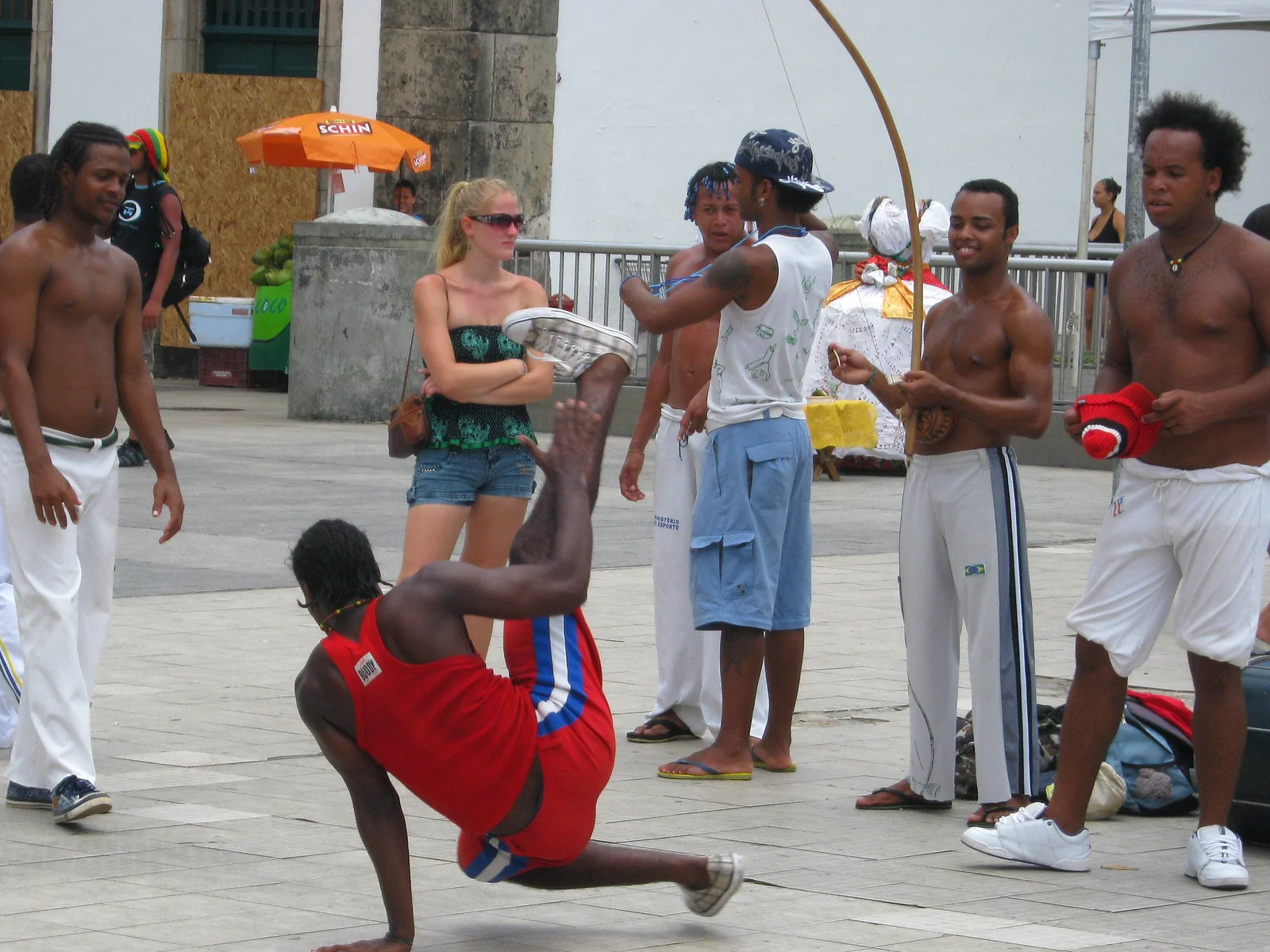
- Largo do Pelourinho — almost every weekend, late afternoon, local groups set up a roda in the centre of the largo, in front of the Igreja do Rosário dos Pretos. The rodas are public and free, but custom is to leave a contribution (R$ 10 to R$ 30) in the hat that circulates. Don't film without asking, and don't try to step into the roda uninvited.
- Forte de Santo Antônio Além do Carmo (Forte da Capoeira) — the official seat of capoeira in Salvador, housed inside a 17th-century fort. Several academies operate inside, and on Wednesday-to-Friday evenings open rodas start around 7 pm. Address: Largo de Santo Antônio Além do Carmo, a 15-minute walk from our suite.
- Praça Tomé de Sousa — in front of the Palácio Rio Branco, especially on Saturday afternoons. A more touristy roda but authentic.
- Terça da Bênção (Pelourinho) — every Tuesday night, the Pelourinho fills with music and capoeira; it's the most alive night in the centre, with spontaneous rodas at several points.
Basic etiquette: clap on the beat, sing when you know the words, leave money in the hat, photograph with discretion, and don't interrupt the singing. Street capoeira is a community roda — you are guests, not paying audience.
Mestre Bimba and Mestre Pastinha — where the history still lives
The two great patriarchs of modern capoeira were born, lived and taught in Salvador. Their memories are anchored at addresses you can visit:
- Memorial Mestre Bimba — Rua das Laranjeiras, in the Pelourinho. Small museum kept by his descendants, with photos, personal objects, the master's berimbaus, open Wednesday to Sunday from 10 am to 5 pm. Free entry; donations accepted.
- Casa de Mestre Pastinha — Rua Gregório de Matos, also in the Pelourinho, where his Centro Esportivo de Capoeira Angola operated from 1955 to 1981. The house today shelters a school that continues his lineage.
- Forte da Capoeira — for those who want to see where most contemporary academies operate, and hear berimbaus playing from start to end of a night.
If the class sparks a deeper curiosity, the Via mestre can chain a guided visit to those three addresses the next day — two hours on foot through the Pelourinho, with the history of capoeira as itinerary. It's a natural extension, and you can arrange it directly with him.
What to bring to the class
Comfortable clothes that allow wide movement: leggings or light pants, cotton t-shirt. If the class is in the suite courtyard, you can be barefoot; outdoors, prefer light sneakers without a heel. A water bottle. Hair tied back. No glasses during the jogo — the berimbau plays, you spin, glasses break. Anyone with a fragile knee or back issue should let the mestre know in advance so he can adapt the sequence. The class is safe and progressive — no one is forced into any movement.
Why learn capoeira in Salvador
You can take a capoeira class in Paris, Tokyo, New York, Buenos Aires — there are academies in more than 150 countries today. But every one of those academies traces back, somewhere in the family tree, to Mestre Bimba or Mestre Pastinha — two men who lived a few blocks from our suite, who trained in the same streets you'll walk this week, who played berimbau in the same largos where the mestre giving the class will play. Salvador is the source. Taking a capoeira class here is a little like learning flamenco in Seville or tango in Buenos Aires: there is a place where the thing was born, where the air of the city still carries the right pulse, and everything you learn there will have a weight the same class on another continent could never have.
It is also the most participatory thing we offer. Everything else — the historic tour, the schooner day, the helicopter — is you receiving Bahia. Capoeira is you stepping into it. The body learns. The music stays. And when you go home, the sound of the berimbau will become one of the sharpest memories of the whole trip.
Through the lens of those who were there
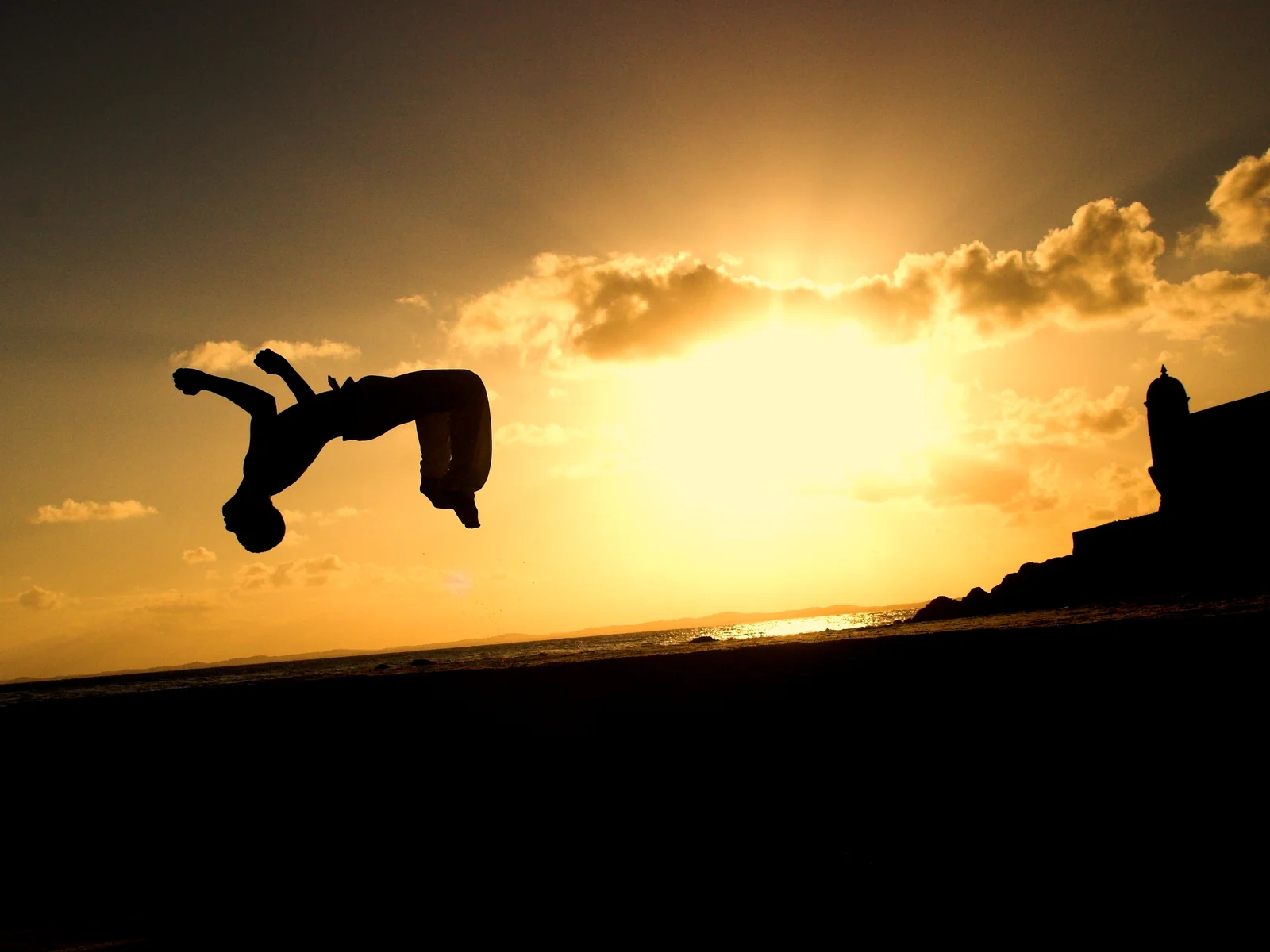
High-resolution photographs of the setting for this experience, with credit to each photographer.
Before you book
Comfortable clothes, barefoot or light sneakers. Book at least 48 hours in advance.
Capoeira Class is waiting for you
Email [email protected] with your dates and chosen suite. We confirm within 24 hours.
 01 / 08
Romance Package
Read more → 02 / 08
Morro de São Paulo
Read more →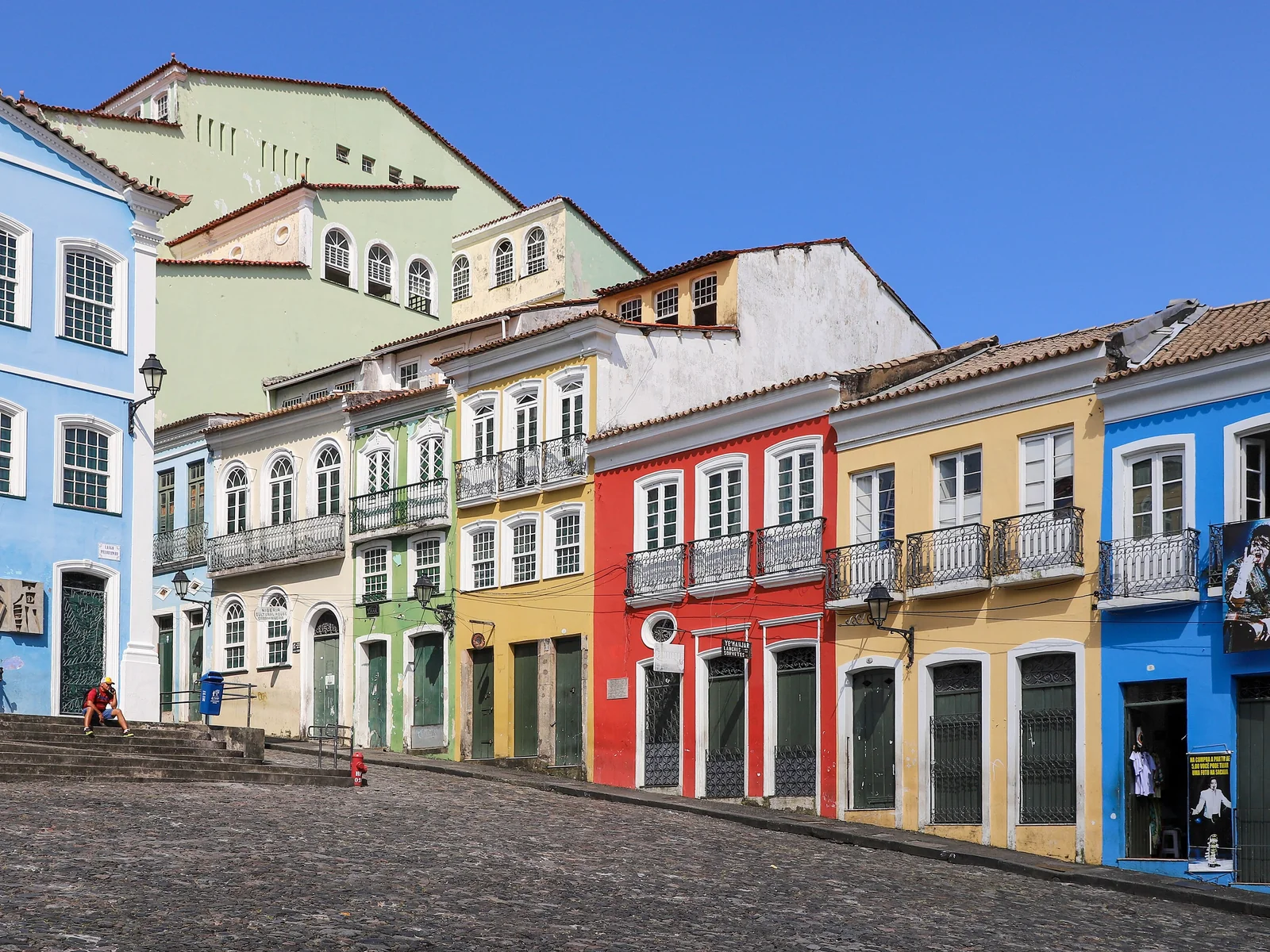 03 / 08
Historic Tour
Read more → 04 / 08
Panoramic Flight
Read more → 05 / 08
Ilha dos Frades Schooner Day
Read more → 06 / 08
Frades & Itaparica Schooner
Read more → 07 / 08